|
U.S.
Deep South
Late Spring can be a hazardous time of year to cycle long distances
through the Deep South in the United States. While pedaling down a highway
in rural Louisiana just after Memorial Day (May 31), I saw many large,
ugly black snakes coiled up alongside the road. They lay still as death
in the warm sun.
Not all of those hideous reptiles were asleep, however. Suddenly one
of them, measuring about a yard long, slithered quickly toward me. I
turned my front wheel sharply to avoid hitting the devilish creature.
Almost simultaneously a car behind me swerved to avoid hitting me. It
was a close call for the snake, the car, the driver, my bike, and me.
At a roadside grocery store I sipped a pint of chocolate milk and recounted
the precarious incident to a middle-aged clerk. Her reaction was nonchalant.
"Yeesss, sir. Them snakes be coming out 'bout this time. It's the
season, honey," she said in a southern drawl.
The temperature rose to 85 degrees Fahrenheit and the humidity hovered
around 90 percent. I perspired profusely as I pedaled down a lonesome
road in flat bayou country pocketed here and there with black, brackish
ponds. I wondered, "Are there snakes hiding nearby waiting to ambush
me?" I quickened my pace.
In Long Beach, Mississippi I stayed at the beautiful home of A.L. and
Nell, an elderly couple who are members of Servas, an international
hospitality organization. Together we watched the evening news on television.
Horrendous tornadoes were tearing up parts of South Texas. "Jim,
thank the good Lord that you aren't biking in those parts!" Nell
said. I wondered, "Which is the greatest danger for touring cyclists:
snakes or cyclones?"
Maybe bugs. For several days I had felt a persistent irritation in my
buttocks. I thought that its source was a boil or blister but I couldn't
see it because the pain radiated from "where the sun don't shine."
Frustrated, I placed my forefinger and thumb around the protrusion and
tugged very hard, finally removing it. I was shocked to see a small
round bug with strong, tiny feet wiggling around the perimeter of its
body. I flushed the repulsive little bugger down the toilet.
In Ocean Springs, Mississippi I stayed with another Servas family: Peter,
Joan, and their 21-year-old granddaughter, Lonnie. They were so fascinated
with my bicycle trip that they invited over a friend and her three children
to meet me. Each one took turns lifting my fully-loaded touring bicycle
to feel its heavy weight. They asked me so many questions about my bike
and trip that I felt like a celebrity on tour.
Numerous Hollywood celebrities entertain at Mississippi's casinos that
are located on large floating barges permanently anchored to a pier.
One evening Peter and Joan went to a nearby casino where they enjoyed
a presentation by the humorist Bob Cosby. In his opening chat Cosby
told the audience, "The only time you should go to a casino is
to eat -- and if possible, for free."
Peter and I drove to a casino where he treated me to an all-you-can-eat
buffet dinner. We gorged ourselves on gumbo soup, crayfish, shrimp,
fried chicken, mashed potatoes with gravy, many kinds of vegetables,
and a variety of million-calorie desserts. The cost for both of us was
only $6.50.
From Ocean Springs I followed Highway 188 into the small town of Bayou
La Batre where the shrimp boat scene was filmed for the movie "Forrest
Gump." The entire town reeked of the awful smell of freshly-caught
shrimp. I took shelter from a downpour in a Hardee's restaurant where
I ordered a hot roast beef sandwich.
I ferried from Dauphin Island to Fort Morgan, Mississippi, then pedaled
past many vacation houses. Built upon wooden stilts, they were painted
in a variety of colors. That cheerful scene suddenly changed when I
spotted several large dead snakes alongside the road. I increased my
speed on the pancake-flat terrain until I reached Gulf State Park.
The park has a lovely campground but, according to a sign near my tent,
it was infested with alligators. In fact, my campsite was located on
Gator Road! That night I zipped up my tent fly securely and decided
to turn northward toward Virginia the following day. "Maybe there
won't be so many snakes, alligators or nasty bugs up there," I
thought.
In Pensacola, Florida I stayed with Doug, Rachel, and their two children
Ian (5) and his sister Lydia (2). Doug is a high school history teacher
and Rachel is a homemaker as well as an amateur artist. Vegetarians
and health-conscience folks, Doug and Rachel are great fans of Dr. Andrew
Weir, author of the best-selling book "Spontaneous Healing."
I followed Highway 90 East to Crestville and crossed into Alabama on
Highway 85 North. In the small town of Florana I camped at a beautiful
state park among elegant, tall trees with Spanish moss hanging from
their branches. Fortunately, I saw no undesirable creepy crawlers in
the area.
As I pedaled northward, the terrain became more hilly, and I tired more
easily. Outside of Troy I stayed with Servas host Ruth, a self-reliant
elderly woman who had biked extensively in Mexico and Africa. Ruth built
her own two-story house on a 2.5 acre homestead. I admired her fortitude,
freedom, and independent spirit.
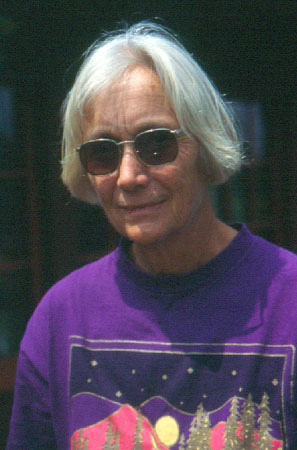
Ruth was a gracious Servas host.
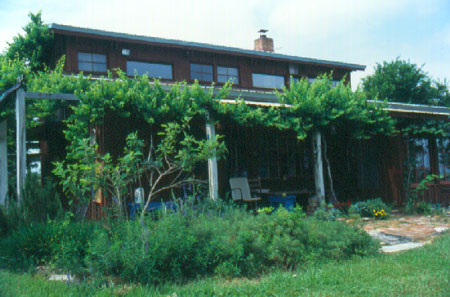
Ruth built this house by herself.
The traffic was very heavy from Tuskegee to Opelika, Alabama but it
thinned considerably when I reached West Point, Georgia. I stayed at
the home of Servas hosts Paul and Emily. That day I biked 117 miles,
which exhausted me. Emily gave me some advice: "Slow down,"
she said. "You can't see anything if you bike a hundred miles a
day." My aching body agreed with her.
But I didn't take her advice. The next day I biked 105 miles over roller
coaster hills across half of Georgia. In Macon I stayed with my friend
Ken who teaches computer science at Mercer University. I was pleased
to learn that the professors of Spanish there had adopted my textbook
"Intercambios." I had a wonderful albeit brief visit with
Ken and his mother-in-law who prepared a delicious shrimp gumbo with
a vegetable called okra. These two folks showered me with true Southern
hospitality.
Not everyone in Georgia was so hospitable. Many huge truckers hammered
past me on Highway 49 and gave me little leeway to pedal my bike. If
I hadn't stopped alongside the road to let one of those hotshots use
part of the shoulder that I was cycling over, I would have become instant
roadkill.
In Milledgeville I stayed with Dwight, a Servas host and a professor
of international studies at Georgia College. I also visited the grave
of Flannery O'Connor, acclaimed for her moralistic stories that combined
comedy and tragedy. She died in 1964 of lupus at the young age of 39.
For twelve hours I pedaled 114 miles across half of Georgia until I
reached Bobby Brown State Park. An obnoxious family of five and their
little white dog parked their travel trailer near my campsite and made
enough noise for ten families. The little girl cried and shouted, the
dog barked, and the family members talked loudly until 1:30 am. They
also left on a very bright light until they went to bed.
The following day I cycled through Calhoun Falls, Pickins, and Pompkintown
from where I began a grueling five-mile climb up to Cesar's Head and
entered North Carolina. My presence clearly irritated most of the drivers
in my lane. They slowed behind me until it was clear to pass. Suddenly
they pushed their accelerator to the floorboard, zoomed around me angrily,
and soon were out of sight. From the summit of Cesar's Head I coasted
downhill all the way to Brevard where I completed an exhausting 115-mile
ride that day.
I stayed with Servas host Roman, who lives on Memory Lane. He explained
how his street received its name. "Some high school kids built
my house as part of a school project. One of those kids was murdered
in a shoot-out over drugs, and another one was killed in a car accident.
My street was named in their memory."
Noticing that I looked rather hungry and thirsty, Roman served me a
large bowl of baked beans, several hot dogs, a huge dish of vanilla
ice cream topped with chocolate, and five glasses of iced tea. As I
ate and drank to my heart's content, Roman told me a great deal about
his passion: studying wild mushrooms.
I left Brevard on Highway 280 which slithers through a lush green mountain
valley. The traffic was relatively light, it was warm, no wind was blowing,
and the road shoulder was smooth and free of debris. It was a wonderful
day to cycle.
Soon I reached Arden, North Carolina where traffic picked up tremendously.
In Asheville I stayed with Servas hosts Gerry, Catherine, and their
18-year-old son Teal. They taught me a great deal about intentional
communities which are like self-sufficient communes.
In Asheville I visited the Thomas Wolfe Memorial dedicated to America's
20th Century writer who is best known for his overtly autobiographical
novels. Wolfe was brought up in a boarding house called Old Kentucky
Home where he wrote frank, realistic reminiscences of his childhood
such as those in his famous novel "Look Homeward, Angel."
The modest furnishings of Wolfe's boyhood home contrasted radically
with the elegance of the nearby Biltmore Estate, home of the Vanderbilt
family. The admission price ($27.95) to the 8,000-acre estate destroyed
my daily budget. However, I thoroughly enjoyed the European-style castle,
its 250 rooms, and the extensive gardens. Biltmore Estate is the largest
single-family residence in the United States.
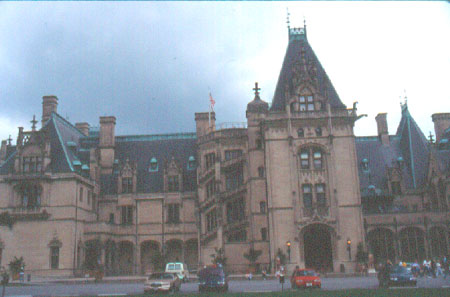
The
Biltmore Mansion, a 250-room house.
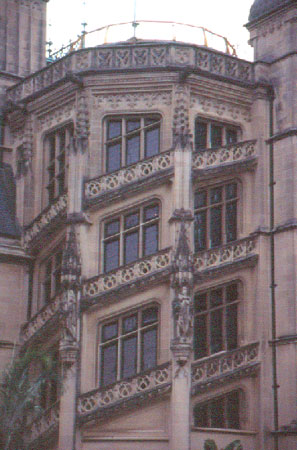
The facade of the Biltmore Mansion
I left Asheville and began pedaling up and down forested mountains along
the Blue Ridge Parkway. All day long thousands of Honda motorcycles
zoomed past me on their way to a massive rally in Asheville. I like
motorcyclists very much because they respect my space as a cyclist,
and they often wave when passing me. Not so with car drivers. At one
point a motorist tried to run me off the road. I instantly headed toward
the ditch while he drove past me as if nothing unusual had just occurred.
I turned off onto Highway 80 towards Burnsville where I stayed with
Servas hosts Joyce and Gilbert who live in a small intentional community.
Their rustic house was stuffed with so many items that I felt like I
was invited to a gigantic garage sale.
Joyce introduced me to one of the most unforgettable men I have met:
Ernest Morgan, a white-haired 92-year-old gentleman. Ernest and his
wife Elizabeth founded the Arthur Morgan School, a small boarding and
day school for junior high school students. The children live with a
dozen staff members and learn practical skills such as preparing vegetarian
meals, planting and harvesting crops, and cutting firewood to heat their
classrooms. "Instead of learning to compete, they learn to cooperate.
They care for themselves, their world, and each other," Ernest
told me proudly.
I continued my journey along the Blue Ridge Parkway, pedaling up and
down hills -- mostly UP, it seemed. I wasn't making much progress and
it began to rain very hard. I thought, "I'm going to get out of
these darn mountains. They roll on all the way through North Carolina
and Virginia. I'm heading for the Atlantic Coast where it's FLAT."
I aimed my bike toward Blowing Rock and coasted all the way downhill
to the town. Suddenly it stopped raining and the sun peeked out from
the clouds. "Was this a good omen of things to come?" I wondered.
I biked several more miles to Boone and camped at Flintlock Family Campground.
The next day I pedaled down Highway 421 to Deep Gap where I had one
of the few flats on this journey. While repairing the flat I saw a large
bulge on my rear tire; it was ready to burst. I replaced it with my
spare tire and followed Highway 268 to Elkin. There were many uphills
and downhills but the general trend was downhill and away from the mountains.
Hoards of impatient yahoos nearly missed crashing their cars and pickup
trucks into me. Fortunately, most of them drove onto Interstate 77 and
vanished from my sight forever.
On top of a hill outside of Elkin I saw five ladies who were having
a yard sale. It was getting late in the day, so I stopped there thinking
that they might let me camp on the premises. "Is there anyplace
I can camp around here?" I asked tactfully, hoping for an invitation.
They suggested that I bike farther on to Pilot Mountain State Park,
then offered me some ice water as we chatted in the shade of a large
magnolia tree.
I continued my way up Highway 268 which was replete with impatient motorists,
most of whom were young guys in pickup trucks. "Get off my road!"
one of them screamed. I did no such thing.
Dark, threatening clouds greeted me as I entered Pilot Mountain State
Park. All around me lightning began flashing, closely followed by horrific
clashes of thunder. The wind blew fiercely as I pedaled as fast as I
could up a very steep hill. Quickly I found a vacant campsite and began
setting up my tent. Just as I was attaching the rain fly, the heavens
opened and the downpour began. I grabbed my gear, threw it into the
tent, jumped in after it, and waited in the dark until the storm subsided.
The next morning I entered Virginia and followed Highway 58 to Martinsville
and Danville. At last I was leaving those cursed mountains with their
narrow roads and obnoxious drivers. I celebrated this victory in Danville
by staying at an inexpensive motel and by enjoying a chopped steak dinner
in a nearby restaurant. Apparently I was quite dehydrated because I
drank three medium pitchers of iced tea with my meal. Afterwards I felt
ill, so I rested in my air-conditioned room, well satisfied that I had
pedaled 95 miles that day.
Rising temperatures, high humidity, and the rush hour greeted me the
following morning as I left Danville on Highway 58 East. I was thankful
that the road was divided into double lanes. There was no shoulder on
the road but I noticed that if I pedaled about two feet left of the
white line in the right lane, drivers behind me would nearly always
swerve into the left lane, leaving an entire lane for me.
I reached South Boston and continued pedaling to Buffalo Springs where
I saw no buffaloes. After stopping in Clarksville for lunch, I cycled
to Boydton and turned into Rudds Creek Campground on Buggs Island Lake.
It was an easy 62-mile ride.
I set up my tent at a campsite that had a nice view of the lake. It
was so peaceful there, especially toward evening when most of the boaters
and swimmers had left. Soon I was the only camper in the park except
for the campground host whose travel trailer was parked nearby.
That blissful peace turned into anxiety during the late evening when
two yahoo couples in cars roared into the campground with their radios
blaring. I awoke from a deep sleep and crawled out of my tent to watch
them.
One couple set up a large tent while the other one lit a bonfire. Soon
they all began dancing around the fire like wild bandits. I had hoped
they didn't see my tent or wouldn't rob or hassle me. Suddenly, one
of them saw me watching. I froze, then thawed when he turned down the
radio volume. I went back to bed but I slept poorly.
The next morning I continued riding along Highway 58 East. All the way
to South Hill I dodged thousands of potholes as hundreds of semi-trucks
zoomed past me. I kept one eye on the road in front of my wheel and
one eye on the traffic in my rear view mirror. It was very hot and humid,
but no matter how much water I drank, it didn't seem to be enough liquid
refreshment.
Suddenly I heard a very loud horn blast just behind me. I aimed for
the ditch as one-half of a long mobile home passed only two feet from
my left leg. I was glad that the driver of the towing vehicle honked;
otherwise I would have been an instant amputee.
I reached Emporia where I finally and gladly left Highway 58. I turned
onto Highway 301 North which had very little traffic. I decided to spend
the night at Yogi Bear Jellystone Park Camp even though it cost $16.27
to set up my tent there. Although I had never paid that much for a tent
campsite, the campground was very clean, it had an air-conditioned TV
lounge, and a pretty swimming pool.
After setting up my tent, showering, and washing out my bicycle clothes,
I biked to the China Star Chinese Restaurant where I had egg soup, crunchies
with sweet and sour sauce, fried rice, shrimp with cashews, and four
glasses of ice water for $7.00 including a small tip. I smiled when
I read the short message in my fortune cookie: "You have great
physical powers and an iron constitution." That night the relentless
heat, the high humidity, and the sharp whistles from passing trains
tested my "iron constitution."
The next morning I followed Highway 301 North to Jarratt where I stopped
for breakfast at a Bilimpie cafe. I continued in a northeasterly direction
through Gray, Littleton, and Homeville. I noticed that if I pedaled
slower than 12 miles per hour, tiny black flies would swarm over my
head and bite me mercilessly. In spite of the heat and humidity, I pushed
my pedals down very hard to deprive those insidious insects of their
human breakfast.
In Waverly I stopped for lunch at Burger King, then continued pedaling
on Route 40 to Spring Grove. I stopped frequently to drink water and
to refill my bottles at grocery stores and gasoline stations. I turned
down Route 10 South and reached Surry in the intense 95-degree heat,
then cycled four more miles on Route 31 to Scotland. There I caught
the free ferry to Jamestown and I pedaled on Route 31 North which led
to historic Williamsburg, the final destination of my bicycle journey.
The temperature had risen to 103 degrees Fahrenheit and the humidity
was over 90 percent. It was a sweltering, exhausting day but I had completed
the last 85 miles of the trip.
I rewarded myself by staying at the Colonial Country Inn where I found
the least expensive room in Williamsburg. After taking a refreshing
swim in the pool, I toured the famous historic district of the town.
Colonial Williamsburg has been restored to the days when the town was
the political and economic center of the Virginia colony. It isn't just
a museum, however. It's a living community where merchants sell their
wares and craftspeople ply their trades.
In the early evening I returned to my air-conditioned room, took a shower,
and tucked myself into bed. Within minutes I fell asleep with the knowledge
that I wouldn't be bothered again by snakes, bugs, alligators, motorists,
high prices, heat or humidity. It was a wonderful way to finish a bike
journey through the Deep South of the United States.
|