|
Southern
Nova Scotia
Bar
Harbor, Maine
In early August my touring bicycle and I arrived in Bar Harbor, Maine,
the departure point for the Lighthouse Tour of southern Nova Scotia,
Canada. Joining us were about 240 other Americans who brought their
bicycles and personal gear. We gathered at the College of the Atlantic,
voted by Princeton Review as having the most beautiful campus in the
country.
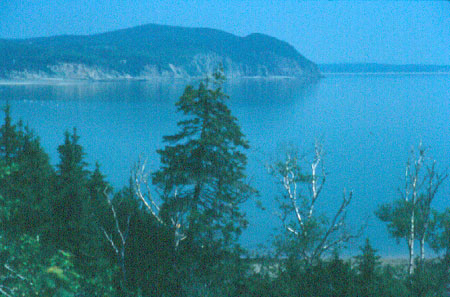
Bar Harbor Bay, Maine
We pitched our tents on the college's expansive lawn, then picked up
our trip packets from Steve and Mimi Bell who had organized the Lighthouse
Tour. Afterwards I took a walk around Bar Harbor which once was a small
fishing and ship-building community.
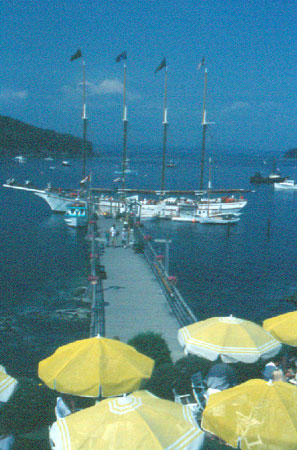
A four-masted ship docked at Bar Harbor
Today Bar Harbor is a bustling town of 4,500 residents, and a favorite
destination for people throughout the world. I strolled along the waterfront
where I saw a wide assortment of fishing boats, schooners, yachts, and
excursion boats. The town's mélange of inns and cottages, artists'
studios, little stores, and restaurants fascinated me. At a tiny cafe
I ordered the lunch special: a hot dog with the works, potato chips,
and a Diet Coke -- all for only one dollar.
The next morning I broke camp and loaded my two duffel bags into a large
Ryder truck. The Lighthouse Tour was going to be fairly plush because
the truck would haul all my gear. Moreover, the tour helpers had painted
arrows on the road to mark the entire bicycle route.
My fellow group members and I boarded The Cat, the largest catamaran
and the fastest car ferry in North America. Called the "Concorde
of the Seven Seas," The Cat crosses the Bay of Fundy to Yarmouth,
Nova Scotia in just two and one-half hours. I locked my bike securely
between a bulkhead and a car, then walked up several staircases to the
top deck. With 750 passengers, 250 motor vehicles and at least 250 bicycles,
the ferry was rather crowded.
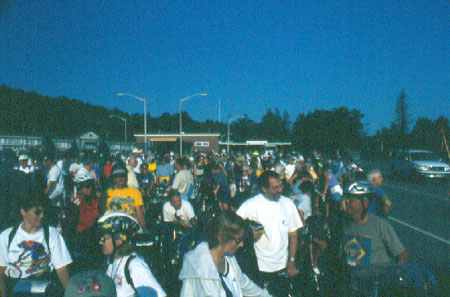
240 bicyclists waiting to board The Cat ferry
to Nova Scotia
Yarmouth,
Nova Scotia
The Cat docked in Yarmouth located on the southwestern-most tip of Nova
Scotia. I rode my bike through town and headed for the grounds of the
local high school. After pitching my tent, showering, and washing out
my riding clothes, I cycled around the community.
Yarmouth was settled in the 1780s primarily by New England Loyalists
from Massachusetts. In the 19th century the town was a leading shipbuilding
and fishing center as well as one of the most important ports in North
America. Yarmouth also became a popular destination for Canadians and
Americans who liked to vacation on the coast and enjoy the temperate
summers there.
Today Yarmouth is the largest town in southern Nova Scotia with approximately
9,000 residents. It is a pleasant place that offers some noteworthy
architecture dating from the golden age of seafaring. The real beauty
of the town is its harbor, fishing fleet, and proud history.
A prominent site in Yarmouth is its lighthouse. The first one was built
in 1840 to guide ships safely in the harbor. In the 1960s this structure
was replaced by a modern, electrically-run lighthouse. On my trip around
southern Nova Scotia I would see many such lighthouses.
After breakfast the next morning I stored my gear in the rental truck
and hit the road. It was a bit foggy, but soon the sun shined brightly
as I pedaled along the beautiful Nova Scotia coast.
The
Evangeline Trail
I followed the scenic Evangeline Trail through fertile farm country
and historic French-speaking villages dating back to the earliest days
of North American settlement. Vicariously I entered the world of the
French pioneers of the early 17th century, New England planters of the
1760s, and of the Loyalists of the 1780s, who had flocked there following
the American Revolution. The Acadians, Nova Scotia's first European
settlers, were expelled from that area. This tragedy inspired Henry
Wadsworth Longfellow to pen his epic poem "Evangeline," from
which the Evangeline Trail takes its name.
Digby
As I pedaled along the coast of St. Mary's Bay, I passed through several
picturesque fishing villages. Finally I reached the outskirts of Digby.
I rested at a McDonald's restaurant and indulged in a fish fillet sandwich
and a small strawberry milkshake.
After lunch I rode to the Lighthouse Tour campground located on the
sports field of Digby High School. Because I was one of the first riders
to arrive there, I had my choice of campsites. I selected a shady spot
atop a small wooded hill overlooking the field. I wanted to distance
myself from the oncoming crowd of cylists to avoid the feeling of being
enclosed in a cattle corral.
Digby was named after Admiral Sir Robert Digby, a British admiral who
arrived there in 1783 from New England aboard his vessel, the H.M.S.
Atlanta. He led a group of 1,500 Loyalists who found relations with
their neighbors rather strained following the War of Independence. The
admiral and many of his followers settled in Digby or farther inland
along the Annapolis Valley.
Today Digby is an unassuming port town with a population of 2,500. It
is home to the world's largest inshore scallop fleet which drags the
ocean bottom for tasty and succulent scallops. Every year during the
second week in August, the town celebrates its way of life and dependence
on the sea with a festival called Digby Scallop Days.
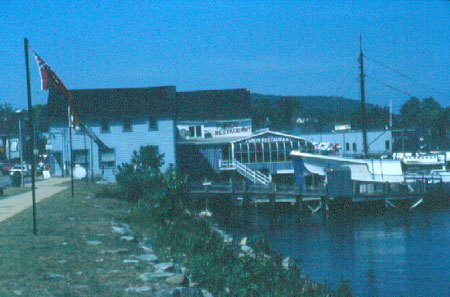
A seafood restaurant in Digby
I rode my bike down to the waterfront where the scallop boats were tied
up. There I saw typical New England wood-frame houses, several gift
shops, and many no-frills seafood restaurants some of which had a spectacular
view of the Annapolis Basin.
The ride on the following day was short; the distance from Digby to
Annapolis Royal was only 25 miles. I cruised slowly along Route 101,
following the marked arrows on the road. It was a joy to cycle through
the Annapolis Valley with its patchwork quilt of fields, dikes, orchards
and vineyards. This is Atlantic Canada's richest agricultural region.
For a half hour I accompanied a couple pedaling at a fast clip on a
tandem bicycle. Later I passed another couple on a tandem recumbent
who traveled at a more leisurely pace. As we left one village, a very
steep hill slowed our progress considerably. I was thankful that my
bike was not loaded down with camping gear!
Annapolis
Royal
I was among the first Lighthouse Tour riders to arrive in Annapolis
Royal. I easily located the Annapolis Royal Academy in whose back yard
I pitched my tent. I assumed correctly that most of the other cyclists
would camp in the front yard of the Academy. I value my privacy highly.
After enjoying a picnic lunch under the shade of a tree, I walked around
town for a closer look.
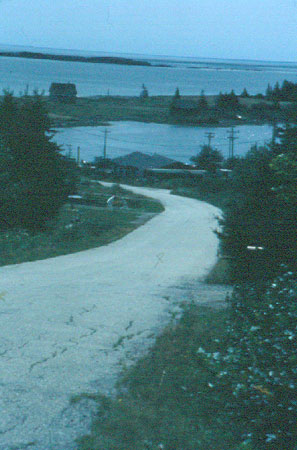
A quiet road near Annapolis Royal
Annapolis Royal is the oldest settlement in Canada. A group of doughty
settlers that included French explorers Samuel de Champlain and Sieur
de Monts founded the town in 1605. Champlain loved the area surrounding
the beautiful Annapolis Basin. "It is one of the finest harbors
that I have seen on all these coasts," he wrote in his journal.
Today Annapolis Royal has 800 residents who are rightfully proud of
their town's heritage as the "birthplace of Canada." They
live in a charming village of clapboard homes with generous porches
facing the sea, expansive lawns, well-tended gardens, and quiet narrow
streets. For over one hundred years the town's residents have been unusually
active in preserving the character of the place. Approximately 150 buildings
and homes there are officially designated heritage sites including the
oldest wooden house in Canada.
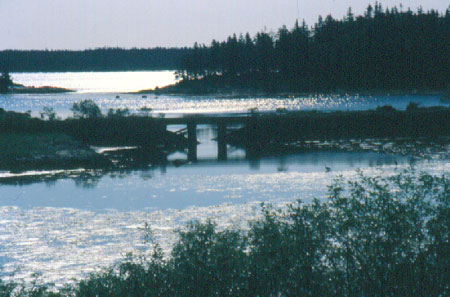
A bridge near Annapolis Royal
No-Pay Ray
While walking around Annapolis Royal I met the most interesting character
on my tour: No-Pay Ray. This American fellow in his early 30s followed
our group on his bicycle which carried all of his camping gear. Ray
refused to pay the required Lighthouse Tour fees, so my fellow cyclists
called him No-Pay Ray. "Why should I pay for this great tour when
all I have to do is just follow the arrows on the road and camp near
the group? I've been doing it for years!" Ray said with a laugh.
Later one of the tour cyclists told me that in Bar Harbor he had seen
No-Pay Ray board The Cat without buying a ticket. Because no one had
collected our individual ferry tickets, everyone assumed that Ray was
part of our group.
Understandably, many of my group members shunned No-Pay Ray as an outcast.
They did not like him because they had paid for their tour, and he had
not. "He's a parasite!" one rider told me. Other group members
regarded Ray as a colorful person. Indeed, he was a controversial character
and the basis for many interesting conversations during the Lighthouse
Tour.
Because heavy rains were forecasted for Annapolis Royal, many of my
fellow cyclists decided to sleep on the floor of the Academy's gymnasium.
When it began drizzling, I jumped into my tent, snuggled up in my sleeping
bag, and soon drifted off to Dreamland.
Across
mid-Nova Scotia
It was still dark and muggy when I rolled out of my sack at five o'clock
the next morning. I ate a small cantaloupe and drank a liter of skim
milk, which provided enough energy to get me on the road. In a light
mist I began pedaling eastward over Highway 8 into the interior of the
Nova Scotia peninsula.
About 25 miles southwest of Annapolis Royal I cycled past Kejimkujik
National Park. A world apart from coastal Nova Scotia, this area is
peaceful, remote, and sparsely settled. It is also quite hilly; the
drumlins or rounded hills were formed by retreating glaciers during
the last Ice Age.
Liverpool
After five hours of spinning my pedals, I reached Liverpool nestled
on the estuary of the Mersey River. There was considerable traffic on
the somewhat narrow streets of town. However, the painted arrows on
the highway marked my route all the way to camp. When I arrived at our
campground on the lawn of a school, I pitched my tent in a remote corner,
showered, then enjoyed a delicious haddock lunch at the local bowling
alley.
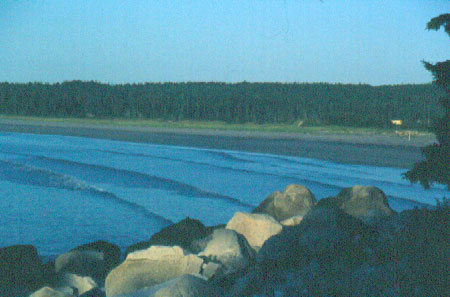
Typical scenery in southern Nova Scotia
Liverpool was originally called "Ogomkegea," meaning "the
place of departure" in reference to its natural harbor. French
explorers Sieur de Monts and Samuel de Champlain dropped anchor there
in 1604. They did not stay long, however, and permanent European settlement
of Liverpool did not occur until 1755. In that year Governor Lawrence
of Nova Scotia arranged with the Massachusetts Government to locate
the descendants of the Mayflower on the south shore of town. Until the
outbreak of the American Revolution, Liverpool maintained strong ties
with the American colonies. From 1776 to 1815, however, the town was
the base of Nova Scotia's privateers and is still known as the "Port
of Privateers." Later it became an important center for ship building
as well as a trading port.
Today Liverpool is a fishing and paper-milling town of 3,200 residents.
The historic area of town is centered around its harbor where Loyalists
fled from the newly formed United States. Many of their homes reflect
the New England style of architecture. For example, some houses have
a "widow's walk," which is a small deck on the roof from which
women would scan the horizon for the homecoming ships of their husbands.
Sadly, some of their men were lost at sea; hence, the name widow's walk.
I returned to camp from my walking tour of Liverpool, hoping that the
misty rain would diminish and the sun would return the following day.
After chatting with several of my fellow cyclists, I hit the sack.
The next morning I left Liverpool just as the sun was rising. It was
peaceful to cycle alone over the hills overlooking the coast. That peace
was interrupted when Jan, a middle-age woman, caught up to me on her
bicycle. I had no difficulty ascending the hills, but they were quite
challenging for Jan. "Go on ahead, Jim. Don't slow down for me,"
she urged. I obeyed, saying that I would see her later in camp.
In the village of Lockport I stopped for a snack break. One of the Lighthouse
Tour helpers was waiting there with trays full of cookies, bananas,
and Gatorade. The 20-mile round-trip detour from the main road to the
cookie van was worth the effort.
Shelburne
In the early afternoon I reached the beautiful town of Shelburne. After
setting up my tent and taking a hot shower in the group campground,
I walked around town.
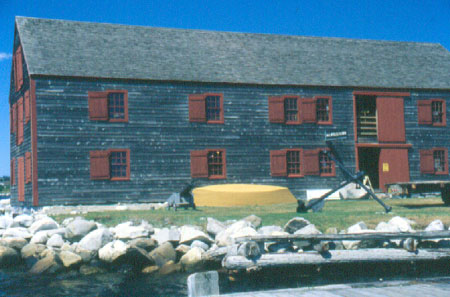
An old warehouse in Shelburne
In the spring of 1783, five thousand United Empire Loyalists fled New
England and arrived on the shores of Shelburne Harbor. They not only
were assured of protection under the British flag, but they also received
promises of free land, tools, and provisions. The town swelled with
newcomers, and by 1784 there were 10,000 people living in Shelburne.
Two years later 16,000 people were living there, making Shelburne the
fourth largest settlement in North America. In the 19th century, Scottish,
Irish and Welsh immigrants arrived to settle in the area. As in many
other coastal communities in Nova Scotia, their principal livelihood
was based on fishing and boat building. Shelburne straddles one of the
best natural harbors in the world.
Today 3,500 people live in Shelburne, many of whom are descendants of
the original Loyalists. They earn a living by fishing, processing fish,
lumbering, and manufacturing barrels and institutional furniture. In
1994 many residents of Shelburne earned pocket money as extras in the
movie "The Scarlet Letter," based on Nathaniel Hawthorne's
novel depicting Puritan New England in the mid 1600s. The film, starring
Demi Moore, Gary Oldman, and Robert Duvall, was shot on location at
the town's waterfront.
In the evening all the Lighthouse Tour riders gathered at the waterfront
for a wonderful salmon barbecue with homemade apple pie for dessert.
As we chowed down on that delicious food, local folk singers performed
for us on stage.
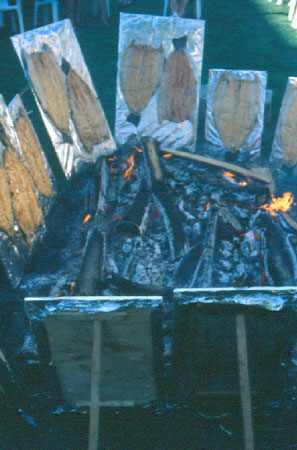
Salmon grilled the old-fashioned way
Suddenly, in the distance I recognized a fellow who seemed to be enjoying
himself immensely. It was No-Pay Ray! He was tapping his toe to the
music of our entertainers as he gobbled down a large piece of apple
pie that someone in our group had smuggled to him. My only thought was,
"No-Pay Ray scores again!"
The next morning I enjoyed cycling alone under sunny skies along the
coastal road. On my left I could make out several outlying islands that
looked like large green dots on the horizon. I pedaled onward through
the picturesque fishing villages of Birchtown, Clyde River, and Barrington.
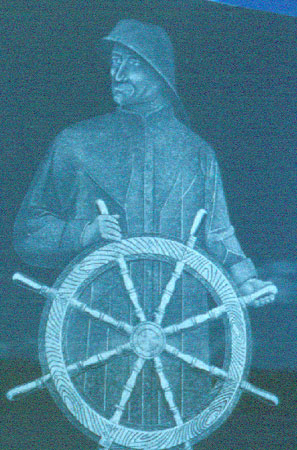
Fishing is an important industry in southern Nova
Scotia
Shag
Harbor
By mid-afternoon I reached Shag Harbor and the grounds of the local
elementary school, our campground for the night. As I helped unload
the baggage truck, I jokingly said to the other volunteers, "This
is our reward for having arrived so early." I set up my tent, showered,
and had lunch while enjoying the natural beauty of the seacoast.
Shag Harbor is such a small fishing village that it rarely appears on
most maps. The village got its name from the word "shag,"
referring to the double-breasted cormorant that is native to the area.
Years ago pirates operated along this coastline, preying on American
vessels to the south, then retreating quickly to the relative protection
of Shag Harbor.
As the day progressed, very heavy fog began rolling in from the coast.
Within a half hour the dense fog reduced visibility to a few feet. I
felt sorry for the riders who had left Shelburne relatively late that
morning. Cycling in that thick pea soup could be dangerous, although
the traffic along Route 103 was fairly light. Fortunately, the latecomers
drifted into camp one by one. That evening over a delicious lasagna
dinner we exchanged stories about our adventures that day.
Journey's
end
The following morning I intended to leave camp very early but when my
friend Jan asked me to change her flat tire, I played the role of Good
Samaritan and came to her rescue. I still was able to get on the road
by 6:00 am. Luckily the fog had vanished during the night and the sun
was slowly rising in the East.
The road was smooth and fairly flat so I decided to challenge myself
to a race. After all, this was the home stretch of the Lighthouse Tour.
I spun my pedals like beaters in an electric mixer, zooming past dozens
of other cyclists some of who decided to give chase.
In less than three hours we arrived in Yarmouth. I read my e-mail messages
at the town's library, then relaxed in the sun while I waited for our
ferry.
As I was boarding The Cat along with 240 of my fellow cyclists, someone
shouted, "Look! There's No-Pay Ray! He's sneaking on with his bicycle!"
Another person screamed, "He didn't pay! He didn't pay!" Several
others began yelling, "Ray didn't pay! Ray didn't pay!" A
crew member of The Cat, who overheard all this commotion, quickly nabbed
Ray and escorted him to the pay booth. At last No-Pay Ray paid the Piper.
"But I paid in Canadian dollars so I got a better deal than you
guys," Ray bragged to me with a big smirk on his face.
As the catamaran ferry traveled at a fast clip toward Bar Harbor, I
sat back on a comfortable lounge chair. I thought about the beautiful
coastal route I had pedaled over the past seven days, the new friends
I made along the way, and the tremendous knowledge I gained about southern
Nova Scotia.
|