|
New
Zealand
Using
the lowest gears on my 24-speed touring bicycle, I began pedaling 11
miles up Haast Past on the west coast of New Zealand's South Island.
I lowered my head so that the hood of my rain jacket shielded my eyeglasses
from the early morning mist. I felt tired, not because I was cranking
slowly to 1,700 feet, but because I had slept poorly the previous evening
when a group of 60 young backpackers partied all night near my tent.
Now they were sleeping peacefully while I struggled toward the summit.
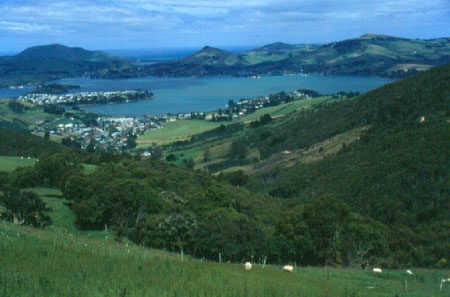
South Island panorama
At Haast Pass it began to rain in massive sheets. Again I lowered my
head and zoomed 35 miles per hour downhill along the twisting, narrow
highway. I held onto the handlebars with my life literally in my hands
and braked so hard that my fingers numbed with pain. Several huge waterfalls
zoomed by on my left, washing over the road. On my right a valley dropped
hundreds of feet into a green, wet oblivion. Occasionally, a car or
a recreational vehicle edged slowly by me, adding to the precarious
cycling conditions and to my high anxiety. Suddenly, I saw a sign ahead:
"EXTREME CAUTION NEXT 2 KMS." I squinted through my glasses
to scan for potholes, stones and rocks on the highway. Only one of those
obstacles could have terminated my trip -- or even my life.
As I rounded a hairpin turn, I saw a tour cyclist on the other side
of the road. Standing motionless in a purple poncho beside a loaded
bicycle turned on its side, he had a lost, helpless look on his face.
Torrents of rain drenched his body mercilessly. But I could not stop
my bike to speak with him: gravity held me in its strong grip. The young
fellow and I were victims of Nature's whims.
Finally, the steep descent from Haast Pass gradually lessened. The highway
became undulating, then gently rolling, then nearly flat. The wind subsided
but the rain continued unrelentingly as I pedaled another 30 miles to
the village of Haast. At its entrance I saw a small sign that seemed
like a mirage: YOUTH HOSTEL.
And what a hostel! It had a large modern kitchen, a lounge with easy
chairs, a color TV, and tidy cabins that slept four people in bunk beds
at $12 per person. I checked into a cabin immediately, showered, and
put on dry clothes. My hellish journey that day ended in a heavenly
oasis less than one mile from the Tasman Sea.
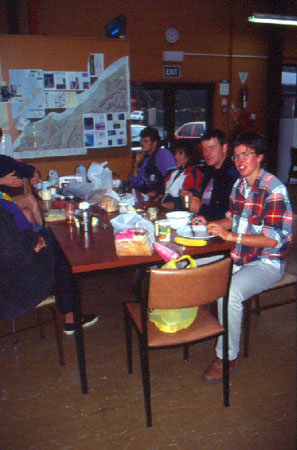
Haast hostel
I had already spent two months pedaling around the perimeters of North
and South Islands in New Zealand. I planned this 3,200-mile self-contained
tour to celebrate the onset of my retirement years. At age 53 I was
in excellent health, and finally I had the time and funds to be totally
free to do what I love most: bicycle touring. Cycling "downunder"
at an average speed of 10 miles per hour for six or seven hours daily
not only kept me physically fit, but it gave me an opportunity to ponder
what I had done with my life and how to spend the rest of it.
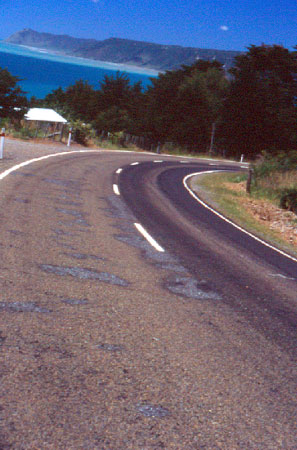
Coastal road on North Island
To climb New Zealand's steep mountain roads I brought with me a Bruce
Gordon "Rock n' Road" Tour-Ex bicycle which came equipped
with tough 26-inch wheels as well as bomb-proof front and rear racks.
My bright red steed was loaded with four Ortlieb waterproof panniers
containing most of my gear plus a two-person tent, a self-inflatable
air mattress, a sleeping bag, and a foam pad. The entire rig weighed
85 pounds which seemed more like a half ton, especially at the beginning
of the trip when I sported a 20-pound pot belly.
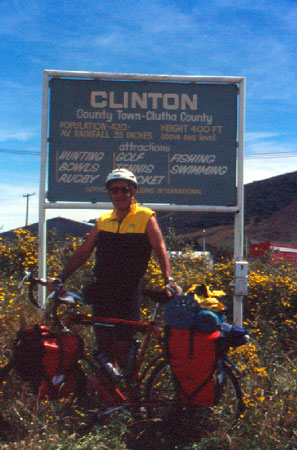
My loaded bike and me
Starting from Auckland on North Island, I biked to Rotorua where I visited
the famous geysers and thermal springs. From there I followed the spectacular
windswept coastline around East Cape which is famous for its Maori culture.
The pohutukawa trees were in full bloom with their red spiny-like flowers
ablaze in the fresh Spring air. In the village of Te Aroha I saw the
grand daddy pohotukawa that is over 600 years old. I continued southwards
along the Pacific Ocean, climbing up and coasting down so many mountains
that my pot belly had flattened.
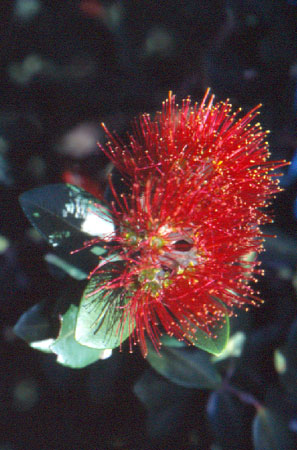
Pohutukawa flower
As I approached Palmerston North, it began to rain and the wind increased
substantially. In a small shop I read a frightening headline in a local
newspaper: "CYCLONE DUE TONIGHT!" That evening the wind increased
to over 60 miles per hour and terrifying torrents of rain blasted the
landscape. Fortunately, I was staying at the home of friends. Otherwise,
the storm would have swept away my tent like a runaway hot air balloon.
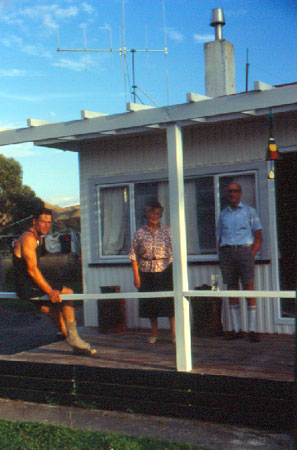
Friends near North Palmerston
After ferrying across the Cook Strait to South Island, I noticed there
was considerably less motor traffic than on North Island. Pedaling down
the east coast to Christchurch and beyond was relatively easy. I enjoyed
sailing slowly over low green hills and grassy flatlands dotted with
thousands of sheep and many vineyards. The weather was mostly sunny
and warm, a stark contrast to a second cyclone that was ravaging the
Coromandel Peninsula on North Island.
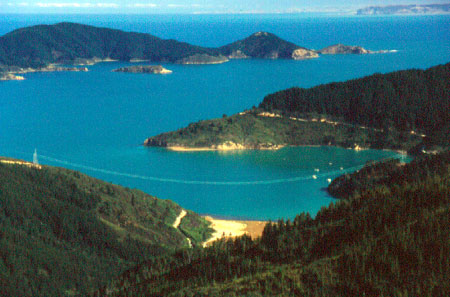
Near Picton on South Island
As I cycled through the New Zealand countryside, the scenery, terrain,
and weather changed frequently. But several things remained constant
during my three-month visit there: the hospitality, the language, and
the humor of New Zealanders. Kiwis are extremely friendly folks who
often invited me into their home for a "cuppa," meaning a
cup of tea or coffee served with small cakes.
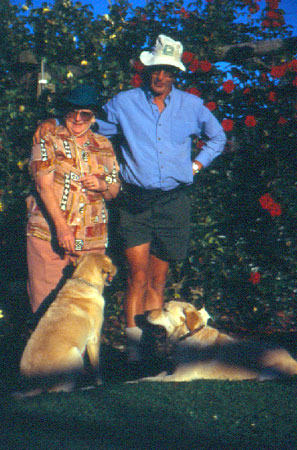
Friends at Nelson on South Island
One day, after enjoying a cuppa and a long chat with an elderly couple,
they asked me to stay for tea. I was somewhat confused by what they
meant but nevertheless I accepted their kind invitation. To my surprise
they set the table and spread out an entire meal. "Tea" means
supper or dinner in New Zealand. During tea I asked for a napkin. My
hostess looked at me strangely, then explained with a smile, "You
mean a serviette, Jim." In Kiwi English a napkin is
a diaper.
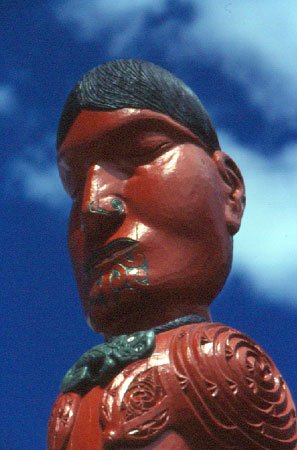
Carving of Maori warrior
In addition to their homegrown English, Kiwis have many interesting
place names. For instance on South Island, I stayed with a host family
on their large sheep farm near the town of Clinton on South Island.
Twenty-five miles down the road is another town called Gore. On North
Island I pedaled by the town of Bulls whose name bares the punch line
of a local joke. A farmer there told me, "That's the only place
in New Zealand where you can get milk from bulls!"
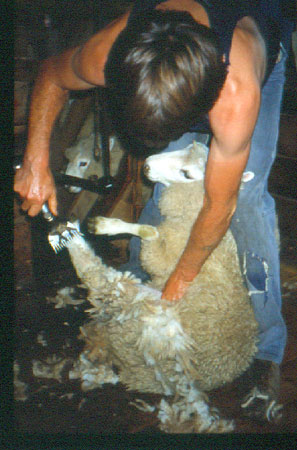
Shearing sheep -- a hard job!
|