|
The
Natchez Trace
In
mid-May I left Nashville, Tennessee and biked down Highway 70 to Mt.
Joliet, then along Highway 171 past Lake Hunter State Park. Fortunately,
a wide shoulder provided some protection against the heavy morning traffic.
I followed Highway 31 South into the small town of Franklin where the
local residents were preparing for a parade. I didn't stop to watch,
however, because I still had a long way to pedal that day.
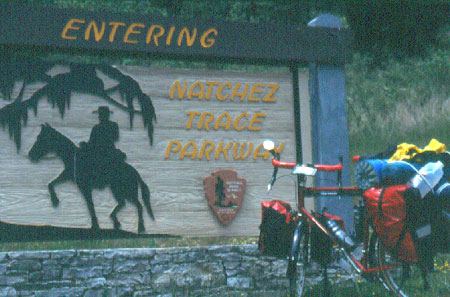
The northern entrance to the Natchez Trace
About
noon I reached the northern entrance to the Natchez Trace. I struggled
up many steep hills but it was fun coasting down them. Soon the sky
darken considerably, threatening to unleash a torrent of rain upon my
body, bicycle, and gear. In the distance lightning flashed at intervals
but I heard no thunderous response. I saw a cyclist on the other side
of the road. "I hope you get ahead of that storm," he warned.
Luckily, within a half-hour the storm blew over, the sky cleared and
the sun shone brightly.
Just after 5:00 p.m. I reached Meriwether Lewis Campground that offered
free camping to all visitors. I pitched my tent on a large flat block
of concrete beside the restrooms. It was a convenient place to camp
and I detected no foul smell in the air. I was surprised that no one
was occupying that pleasant site.
Two retired fellows in their 60s from Arizona, Jim and Oli, camped near
me on scrubby terrain. Unfortunately, their tents were not free-standing
as mine was so they struggled to stake them down in the rocky earth.
After supper I washed up with water from the spigot inside the restroom
because no shower was available. I also washed out my clothes in the
sink. A park ranger had scheduled a campground program to begin at 7:45
but I was too tired to attend it. After all, I had pedaled 103 miles
that day.
Instead, I chatted with a 10-year-old boy and his younger sister who
stopped by my campsite. The boy explained that they had nine other brothers
and sisters, and that their family was traveling in a bus loaded with
bunk beds. "We're looking to rent a house around here," the
boy said. "My father finally found a job." The boy seemed
quite surprised to learn that my tent cost two hundred dollars. I assumed
his 12-member family was fairly poor.
The next morning I said good-bye to Jim and Oli. Because I had slept
poorly on the cement slab, I was glad to hit the road again. My bicycle
and I flowed slowly over the smooth Natchez Trace highway. The few motor
vehicles that passed by did not disturb me. I was in a meditative mood,
lost in my own day dreams. Just me, my bike, and the road.
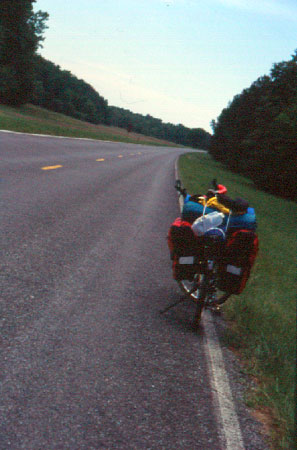
There was very low motor traffic on the Trace.
At Collingwood I briefly left the Natchez Trace to buy some groceries.
After lunch I continued pedaling south and soon I crossed a long bridge
spanning the Tennessee River. I turned into the Colbert Ferry area and
found a campground specifically for cyclists. After setting up my tent,
I washed up in the nearby restroom. It was wonderful to feel clean again
especially after biking 64 miles.
As I gobbled down a bowl of cereal with milk for supper, I studied my
AAA map. Someone had left an Adventure Cycling map in the camp registration
box so I studied it as well. The map covered the entire length of the
Natchez Trace.
After supper I rode my bike a short way down a hill to the Tennessee
River where many visitors had launched an assortment of boats. As I
relaxed on the lawn there, I watched a man water-skiing up and down
the river. Soon a speedboat came by pulling a teenage girl in a rubber
raft. "To each our own thing," I thought. "My thing is
bicycle touring."
The next morning I continued pedaling down the Trace. It rained off
and on all day. Sometimes the sun shone and sometimes it drizzled. And
once it poured like a fat garden hose turned on full. It was a long
day's ride.
By early afternoon I reached the Tupelo Visitor's Center where I met
Albert, a cycle tourist from Alabama. "This is my first bike tour,"
the 20-something fellow said. "I'm biking north to visit a friend."
A park ranger at the Center informed me of a free primitive camping
area located in the woods across the highway. "You're welcome to
join me," I said to Albert.
We pedaled to the edge of the woods and walked our loaded bikes down
a rough trail. Soon we came to a large clearing where we saw three rustic
cabins, a water spigot, a small outdoor amphitheater with benches, and
an outhouse. Brown and yellow leaves blanketed the ground from the previous
autumn. The place was deserted. Albert set up his tent in one of the
cabins and I did likewise in another.
Afterwards, we walked several miles to a Wal-Mart in Tupelo. The store
was farther than I thought but it was worth the long hike there because
I found a McDonald's restaurant where I had lunch. I also bought a quart
of milk to eat with cereal at breakfast the next day.
When Albert and I returned to camp, I shaved and washed up under the
outdoor spigot. The water was cold but it felt clean and fresh against
my skin. Keeping clean on a bicycle tour is one way to maintain good
health.
Our campground seemed quite isolated. In fact, a park ranger at the
Visitor's Center had told me, "That area is a secret. We don't
give out its location unless someone asks for it." I explained
that I knew about the campground from the Adventure Cycling map that
I had found at Colbert Ferry the day before.
At about six o'clock in the evening, a strange and potentially dangerous
incident transpired. Albert had walked back to the Visitor's Center
to telephone his brother. When he had not returned to camp for a long
while, I felt something was wrong.
Unexpectedly I saw a fellow in his mid-30s walking slowly along the
path through the woods. The man was partially bald and he seemed to
be quite fit. Suddenly, he saw me watching him. He stopped walking,
looked at me from a distance, then continued walking very cautiously
toward me. When he was about one hundred yards away, he stopped again
and stared.
"Hi," I said to break the tension. He didn't answer although
I knew that he had heard my greeting. Instead, he stared at me suspiciously
and longingly. I felt very uncomfortable and apprehensive.
A few minutes later Albert appeared in the distance. A rather plump
fellow about 25 years old with a short black beard was following him
about a hundred feet behind. It was a relief to see Albert again. I
felt safer. When the plump guy saw me, he froze. The balding fellow
continued his silent vigil.
Finally, Albert approached me and spoke in a frightened, gloomy tone.
"We've got company," he said sadly. We sat on top of a picnic
table and discussed the matter at hand as we watched the two intruders
who were observing us silently from afar. "Those two guys followed
me into the woods," Albert said. "They're kinda spooky."
As we chatted, both spooky fellows began retracing their steps out of
the wooded area. Albert and I felt relieved. "Let's go talk to
a park ranger about this, Albert" I suggested. "Good idea,"
he answered.
We walked slowly behind the retreating spooks. The plump stalker got
into his pickup truck and left. To our surprise, the balding starer
stopped to talk with us. He wanted to know what we were doing in the
woods. After we explained that we were going to camp there for the night,
he left in his car.
The Visitor's Center had closed so Albert phoned the local sheriff.
When the officer arrived in a squad car, we explained our frightening
situation. The officer pointed to the highway and said, "Across
the street is a well-known gay pick-up area. The parking area over there,
the Visitor's Center restroom here, and two places down the street are
where gays come to look for pick ups," he explained. "But
don't worry, they're harmless. They won't come back again tonight."
Albert and I didn't want to take any chances on the sheriff being wrong,
so we asked his permission to camp next to the Visitor Center. "Ok,
no problem, fellows," he said, understanding our anxiety and concern
for safety.
Albert and I return quickly to our campground, took down our tents,
and repitched them under an overhanging roof beside the Visitor Center.
As the sun went down, we chatted at great length about what had happened
that afternoon and what could have happened to us.
As I lay in my sleeping bag that night, I said a silent prayer of thanks.
It had been a long, adventurous day.
Albert and I awoke at 6:00 am. During the night I woke up and went back
to sleep at least twenty times. Horrible scenes of rape, murder, and
robbery filled my dreams.
After packing my gear, I ate a large breakfast, then said good-bye to
Albert. I wished him good luck on his trip and began biking southwards
along the Natchez Trace. There were few uphills along the way, and I
averaged nearly 14 miles per hour.
At 12:30 p.m. I arrived at the Jeff Busby Campground. Albert would have
been surprised that I had pedaled 73 miles so quickly in one day. He
had expressed some doubt that I would reach the campground. Fortunately,
the road was slightly downhill all the way and a tailwind provided an
extra boost.
Nobody was at the campground, which made me feel apprehensive. I didn't
want to camp alone; that seemed dangerous, especially when I thought
about the previous day's events with the two gay stalkers. But the shopkeeper
in the campstore assured me that I would be fine. "We've never
had any problems," he said. "And you won't be camping alone
today. Some people in cars and RVs will be pulling in around 5:00 p.m.
or so."
He was correct. Later that afternoon some folks in RVs and several couples
on motorcyclists arrived at the campground. I felt relieved and safe.
After supper I sat at my picnic table and wrote in my journal a list
of items that I thought made the day successful:
* I made better time than I had expected.
* I completely washed up with cold water in the men's restroom before
anyone showed up in camp.
* I could choose to camp on any site because I had arrived so early.
* The campstore was well stocked with food.
* I felt quite safe.
* It wasn't raining.
At 5:30 the next morning I woke up to the natural world that surrounded
my tent. I lay in bed listening to birds singing in the tall trees nearby.
By their varying songs I counted five different kinds of birds. I felt
fortunate to attend their melodious concert.
By 7:00 a.m. I packed up my tent, ate breakfast, and was rolling down
the Natchez Trace once again. The road was mostly flat, so pedaling
was easy despite a light drizzle. I stopped briefly at French Camp for
a pit stop and to look around a bit. On the left side of the road I
saw several log cabins in a large clearing in the woods. Wooden fences
marked the perimeter of the area. I felt like I was transported back
in time over 100 years ago.
One of the log cabins was a bed and breakfast lodging. Another was a
small cafe from which the smell of bacon and pancakes permeated the
air. A sign posted outside the cafe announced that it would open at
8:30 am. I looked at my watch and thought, "Hmm. It's eight o'clock
and I just ate breakfast. I don't want to wait a half-hour to have a
second breakfast. And I don't want to spend money on another one."
The light drizzle turned to steady rain. I continued pedaling in a southwesterly
direction along the Trace until it ended just north of Jackson. That's
where the confusion began.
I saw a sign that read: BICYCLE INFORMATION. I looked around and felt
perplexed. "Where is the information?" I wondered. I biked
to a nearby building that was a combined gas station and grocery store.
I stopped an elderly man who was entering the place and asked him directions
to Goshen Campground. According to my map it was somewhere east on Highway
43. The man pointed east and said, "The campground is just over
four miles that way."
I started cycling down that busy road which soon became a dike with
water on both sides. After a few miles I felt that something was wrong.
I sensed that I had gone the wrong way. I turned around and rode past
the gas station-grocery store. There seemed to be a small motel ahead.
I thought, "Maybe I'll get out of this wet weather and stay there
for the night."
As I approached the string of motel units, I could see that the owner
had the business long ago. I saw a young woman outside her house nearby
the motel. I asked her if there was a motel or hotel close by. She had
no suggestions.
I pedaled past the gas station-grocery store once again, and rode to
exit where I had left the Natchez Trace. A park ranger was collecting
garbage there. I said, "Excuse me, sir. I saw a sign over there
that says 'Bicycle Information' but I couldn't find any."
"There's a little box by the sign," he answered. "In
the box are maps for bicyclists. The maps show you how to get back on
the Trace on the south side of Jackson."
I pedaled to the map box, embarrassed and angry with myself that I hadn't
seen the darn thing. But when I opened the box, it was empty. I rode
back to the park ranger and told him that the map box was empty. "I'm
sorry, young fellow," he said. "I can't help you."
I was very tired and hungry. I stopped at the gas station-grocery store
where I bought some chocolate milk and chocolate donuts which I devoured
on the spot. That junk food and the short rest gave me energy to pedal
northwest on Highway 43 North eight miles to the small town of Canton.
On the way, the rain finally stopped. I felt strongly that my luck was
changing from bad to good. I continued pedaling to Ridgeland on 51 South.
A small triangle beside the word "Ridgeland" indicated that
there was a campground nearby. An employee in a grocery store confirmed
that fact. "I've heard of it but I don't know where it is,"
she said.
I stopped at a gift shop to ask the location of the mysterious campground.
The clerk didn't know but she was amazed when I told her that I bicycled
there from Nashville. I stopped at a discount bakery store. The clerk
didn't know where the campground was located. I cycled to a craftshop
where I inquired once again.
The woman employee asked in a long Southern drawl, "You mean Timberlake
Campground? That's five miles from here. But there's a Comfort Inn and
a Red Roof Motel about two miles away."
"No, I want to go to the Timberlake Campground," I said thinking
of my frugal nature.
The woman nodded, then patiently drew a crude map and explained how
to reach the campground. "You'll have to go up here to the spillway
and bike along the top of it. Be careful now, it's busy at this time
of day. Timberlake Campground is just on the other side of the dam."
I thanked the woman profusely, then I headed out again, armed with my
hand-drawn map. I also said a silent prayer. I entered the rush hour
traffic of Jackson, and found my way across the spillway. On the other
side was seemed to be a wonderful mirage: a McDonald's restaurant! To
me a McDonald's means inexpensive and tasty food, clean restrooms, and
familiarity that gives me a sense of confidence, security, and feeling
at home.
I stopped at a gas station where an employee gave me directions to the
Timberlake Campground which was just a few blocks away. Excited, I pedaled
there quickly and found it to be a fine campground. "It's going
to be expensive," I thought.
The cost was $8 to set up my tent and included a hot shower. It wasn't
a bad deal after all. Besides, I was very tired, it was already 5:30
p.m., and I had biked 120 miles. I found a site in a tents-only section.
I was the only camper there. After pitching my tent, I took my first
hot shower in one week. It was great!
Then the finale of the day: I walked to McDonalds for supper and truly
pigged out. I treated myself to a chicken deluxe sandwich, French fries,
two tall glasses of lemonade, and two hot apple pies. Sometimes life
is so sweet. The next morning I couldn't resist returning to McDonald's,
this time for a filling breakfast of a sausage and egg McMuffin, hashbrowns,
and coffee -- all of which cost only $1.65 because I asked for and received
a senior discount.
I rode across the spillway again which had considerably less traffic
on it compared to the day before at rush hour. I turned left on Old
Canton Road and followed it to Country Line Road which took me to the
outer fringe of Jackson. I continued straight on County Line Road and
stopped at a small post office in Tougaloo. There I asked for directions
to Clinton, Mississippi and the Natchez Trace.
I followed Cynthia Road to Clinton, a pretty highway leading to a pleasant
town. I followed Melrose Road to its end at Mississippi College, then
turned right and headed downhill out of Clinton. It was getting warmer
so I took off my Gore-tex jacket.
I continued pedaling toward the Natchez Trace and soon reached a frontage
road that paralleled Interstate 20. I saw an exit sign announcing the
Trace but somehow I didn't see the entrance because there was no other
sign announcing it. I continued pumping until the frontage road ended.
Now where to go?
Instinctively, I turned left and rode under the Interstate onto a frontage
road on the other side and followed it back. I asked a man for directions.
"Just keep going up this road and you'll see a sign to get on the
Natchez Trace," he said.
He was correct. Soon I saw a sign: EXIT 34: NATCHEZ TRACE PARKWAY: 1
MILE. I looked at my cyclometer to be sure I wouldn't miss the exit.
After one mile the frontage road curved to the right away from the Interstate,
then came around and paralleled it once again. I pedaled under a bridge
over which I assumed passed the Natchez Trace. I rode a bit farther
on the frontage road, then noticed a break in the fence. I saw a sign
bearing only the letters "M, M" with an arrow pointing to
an opening in a fence. I had no idea what those letters represented
but I felt that the arrow would lead me to the Trace.
I was correct. I had no other alternative than to bike up the wrong
side of an off ramp and finally reached the highway. What a hassle!
I wished that I had received better directions for finding my way to
the Trace from the point where it ended north of Jackson.
I pedaled down the Trace about seven miles and exited onto Highway 467
leading to Edwards, Mississippi. After pedaling down that road for nine
miles, I arrived in Edwards, a small town with mostly African-American
residents. From the Champion Hill grocery store I telephoned Rich who
is a member of Servas, an international homestay organization. I made
arrangements to stay with him and his wife for two days. Rich said that
he would be home about seven o'clock that evening.
I bought some lunch food at the grocery store. When I gave the teenage
cashier a $50 traveler's check, she looked at it carefully and frowned.
"What's that?" she asked.
"It's a traveler's check."
"A what?"
"A traveler's check. It's as good as cash," I explained.
"I ain't never seen one a dem," she said. "I have to
check with my supervisor."
As I watched her walk to a nearby counter to speak with her supervisor,
I thought it was incredible that the cashier had never seen a traveler's
check. "Is this the end of the 20th century or the beginning?"
I wondered.
The cashier returned and looked satisfied. "It's okay," she
said, and gave me my change.
As I was coming out of the grocery store, I noticed that an African-American
teenage boy was looking at my loaded bicycle. "Where you headed,
man?" he asked.
"Down the Trace, then over to Florida and up to New England,"
I answered.
"Woooooie! Damn! Where do I sign up?"
I laughed. "Just get on your bike and go," I said and waved
good-bye to the young fellow.
I cycled a bit around Edwards, passing Rich's fading yellow Victorian
mansion across the street from the Merchants Bank, the most modern building
in town. I returned to Rich's house and carried my bike and gear up
to his front porch. I relaxed and had some lunch.
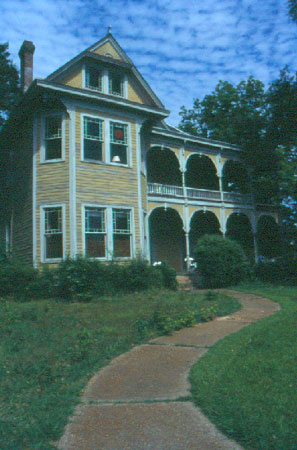
Rich and Jackie live in this Victorian mansion
in Edwards, Mississippi
At 2:50 p.m. a long freight train rolled by the mansion and shook it
a bit. The engineer blasted the whistle as the train rolled under the
crude single-lane wooden bridge. "Edwards truly is a small Mississippi
town," I thought. At first I felt apprehensive being a white minority
in a majority black town, but soon I got over that negative feeling.
Visitors to new places often bring along their prejudices and fears,
as I did.
Rich returned home from work at seven o'clock. He showed me his huge
house that has three parlors filled with antiques including various
pianos and a harpsichord. "We have live concerts here," Rich
explained. "Friends from all over the United States come and play
their various instruments. We have a good time."
I followed my Servas host up a winding staircase to the second floor
of his mansion. He showed me to my bedroom, one of seven in the house.
"My wife Jackie and I are fixing this place up," he said.
"You can sleep in any one of these bedrooms up here. The bathroom
is down that long
hall."
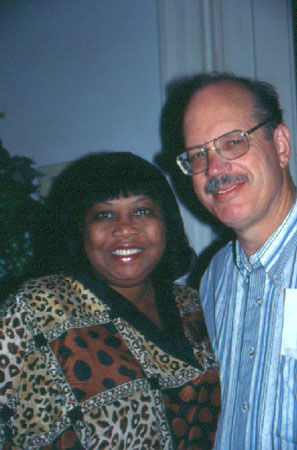
Rich and Jackie, my Servas hosts
Rich and I had supper and a long conversation. He is a Caucasian married
to a delightful African-American woman. I met Jackie at about ten o'clock
that evening when she returned home from Jackson where she taught French
at a high school. "I'm sorry that I'm so tired," she said.
"Someone broke into my classroom and stole all the final grades.
I had to stay after school to recalculate them all. Some of my students
and a few parents helped me." The three of us chatted briefly and
retired for the evening.
The next morning Rich and Jackie left for work at seven o'clock. I had
breakfast alone in their huge dining room. My plans for the day were
to visit Vicksberg located about 17 miles from Edwards. At first I pedaled
the wrong way out of Edwards. After asking directions at a dental clinic,
I rode back into town and out the other end on Highway 80. I crossed
the Big Black River and climbed a series of hills that led me into historic
Vicksberg.
I stopped at a tourist information office to get a local map before
riding across the street to visit the Vicksberg National Military Park.
First, I saw a short free movie entitled "The Siege of Vicksberg."
Afterwards, I pedaled through part of the cemetery. I saw green fields
of monuments dedicated to both the Confederate and Union troops of the
Civil War. "What a waste of good people," I thought.
I pedaled around Vicksberg, past the Coca-Cola Museum which I wanted
to visit but didn't because I had already seen many Coke memorabilia
at the headquarters in Atlanta. I rode past numerous ante-bellum mansions,
each costing $5 to tour, so I passed them up.
I stopped at the Old Court House Museum and toured it for $2. The admission
fee was money well spent. I was especially impressed by a small exhibit
which explained a story worthy of Ripley's Believe It or Not Museum.
The story goes like this: During the Civil War a young soldier and a
young woman were standing beside each other. Suddenly, a shot rang out
and a bullet passed through the testicles of the soldier and into reproductive
organs of the woman. As a result of this freak accident, the woman became
pregnant. After her baby was born, the couple -- who didn't know each
other at the time -- got married. In time they produced two more children
"through the conventional way," according to the sign in the
showcase which displayed the actual bullet that caused the couple's
first pregnancy.
From the museum I pedaled down to the Mississippi River where I visited
several casinos. In Mississippi all casinos are built on barges because
the state law forbids them to be constructed on land. The exteriors
of the casinos looked like giant stern-wheelers in a Mark Twain novel.
The interiors, decorated in red and gold and thousands of glittering
lights, were jammed with slot machines at which greedy men and women
played their luck and mostly lost their money. I stayed only ten minutes
in two casinos, then pedaled back to Edwards as ominous rain clouds
darkened above me.
After taking a shower at my hosts' mansion, I ate lunch and rested.
Suddenly, the sky filled with lightning and thunder followed by a massive
downpour. One might have thought the Civil War had started all over
again. I thought how fortunate I was to nestle inside a cozy old home
during such nasty weather. Luckily, I had just missed the storm.
The next morning I took a picture of Rich and Jackie in one of their
elegant parlors. After thanking them and saying good-bye, I mounted
my bike and retraced my steps nine miles down Highway 467 to the Natchez
Trace.
Soon I saw three other cyclists ahead of me. I was fairly sure they
didn't have fully-loaded panniers aboard as I did. It was difficult
keeping up with them. Suddenly, the cyclists slowed their fast pace
and I was able to meet them. They were all about 19 years old and were
enrolled in a dental school in Jackson.
"We're out for a 40-mile ride on the Trace," one of the students
said. We slowed down for you and hoped to hear a few stories."
He had very black hair and a freckled face. We rode together for a while
but the freckled face guy spoke with me. His buddies just rode their
racing bikes and listened to my adventurous bicycle stories. After a
half hour, the students turned around and returned to Jackson.
Soon it began to rain, softly at first, then harder and even harder.
Lightning flashed and thunder boomed across the sky. I was quickly engulfed
in a downpour. I didn't bother to put on my rain jacket, however, because
I would have perspired in it anyway in the high humidity. I pedaled
for at least 3 hours in the rain but escaped being struck by lightning.
Gradually the rain stopped and the sun peeked through a rain cloud.
I felt relieved and wanted to dry out. I reached nearly the end of the
Trace, then followed an off ramp leading to Natchez State Park. Just
before reaching the park, I stopped at a small grocery store to buy
food.
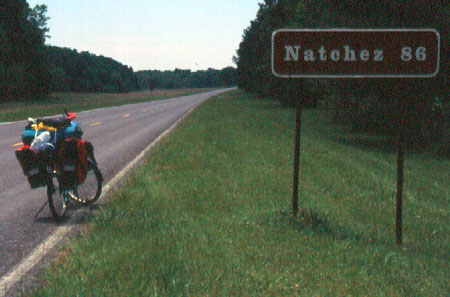
Only 86 more miles to Natchez
After a brief rest, I headed straight for the campground. It cost $11
to camp on a concrete block or $7 to camp in a "primitive site"
area. I went to the latter where I saw two tents set up but no one was
around. The ground was very muddy from the heavy rain and everywhere
were 6-inch ruts made by campers' cars and trucks. Most of the terrain
inclined toward a small river, so it was difficult finding a flat place
to pitch my tent. A park ranger stopped by to collect my camp fee. He
pointed out a flat place between some trees near the entrance to the
primitive area so I decided to camp there.
I walked a long way to take a shower and to wash out some clothes. Then
I ate supper and wrote in my journal. I was quite tired so I went to
bed at 7:30. Within a half hour three ignorant yahoos -- two young men
and one young woman -- returned to the primitive areas in an old dilapidated
car. Both men sat in the front seat. The woman got out of the car and
sat in one of the two tents. The threesome were definitely in an argumentative
mood.
"I did give you some money, Jack" the woman insisted.
"You didn't give me no money, Debra."
For nearly an hour they argued over money: not having enough, getting
more, and drinking beer as they squabbled among themselves. Once in
a while, one of the fellows laughed uncontrollably.
Obviously I couldn't sleep with all that racket. So I decided to move
my tent, gear, and bicycle to another area. It was nearly dark. I moved
my belongings to the "regular" camping area, fully expecting
to pay a four-dollar upgrade, and pitched my tent in the dark on a concrete
block.
Fifteen minutes later it began to rain. Suddenly, some water began flowing
under one side of the tent. In my haste I had forgotten to tie down
the rain fly. I got out of the tent and scrambled to complete the job
usig a stick and some old tent poles that someone left behind. I went
back to bed feeling safer, drier, and somewhat peaceful.
I woke up at about six o'clock the next morning. Although I had slept
poorly, I wanted to break camp and leave as quickly as possible. As
I packed my soaked tent, I heard the same threesome arguing about something
or other. I was very happy that I had left that area which was, indeed,
quite "primitive."
As I rode down Highway 61 to Natchez, I saw a fine public campground
on my right. "Darn," I thought. "I wished I had camped
there last night. It would have been worth paying ten dollars extra
for a comfortable site and peace of mind."
I stopped at a Hardee's and ordered their breakfast special: a bacon-filled
biscuit, egg and cheese, and a senior coffee. A friend of mine would
have called that a "by-pass special." I knew that the sandwich
was high in cholesterol and it even tasted greasy. But the coffee went
down well, although I'm not a coffee drinker.
As I rode into Natchez, I thought about the past nine days. Like the
Natchez Trace itself, those days were filled with many "ups and
downs." But such is life in which each day has its good and bad
points. I believe it's wiser to remember the good points and let the
bad ones fade into history.
|