|
Maine
to Québec City
In
late July my touring bicycle and I landed at Bangor, Maine to participate
in Maine's Original Outstanding Super Adventure (MOOSA). I assembled
my bike in the airport terminal, then pedaled over a busy highway to
the local Super 8 Motel. A half-dozen riders and their boxed bicycles
were waiting there for a shuttle bus driven by Steve Bell who had organized
the MOOSA Tour with his wife, Mimi.
When Steve arrived, he attached my two-wheeler to a rack in the front
of his van and stored my duffel bags in the attached trailer with the
other riders' bicycles and gear. Together we drove through heavy traffic
to the town of Skowhegan, located about 55 miles west of Bangor.
Skowhegan lies in the beautiful Upper Kennebec Valley in North Central
Maine and has a population of 9,500 people. In Abnaki, a local Native
American language, the name Skowhegan means "the place to watch
for fish."
Nearly 200 MOOSA riders gathered at the Skowhegan High School. I set
up my tent in a shady spot on the school lawn. Perhaps Native American
families had lived in their tents on that very spot long, long ago.
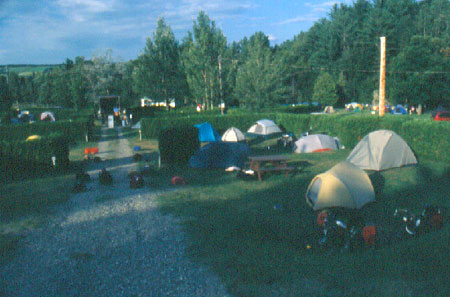
A typical campground in Maine
The following morning I broke camp, attached two small panniers to my
rear rack, and loaded my duffel bags into a rented truck. This tour
was going to be fairly plush because the truck would haul all my gear.
Moreover, the MOOSA helpers had painted arrows on the road to mark the
entire route from Skowhegan to Québec City.
I pedaled northward on Route 201 along the beautiful Kennebec River
that flowed through a picturesque countryside. This is the extreme northern
part of the Appalachian foothills. Soon I reached Bingham, a valley
town of attractive houses and manicured lawns, and home to 1,200 citizens.
It was named for William Bingham, an influential Colonial-era banker
who owned over two million acres of Maine land in the 1780s. Interestingly,
the town is equidistant between the North Pole and the equator (3,107
miles in each direction) and is situated right on the 45th parallel.
The local residents call the highway north of Bingham "Moose Alley"
because many moose live in that area. Unfortunately, motor vehicles
hit those huge animals, resulting in numerous fatalities of drivers
and moose. The region is also home to more than 100 species of birds
so although it seemed lonely there, I was not alone.
Finally I reached Jackman where 1,000 people live. The town is named
for Captain James Jackman who built the Canada Road (today Route 201)
from The Forks to the Canadian border around 1813. This was the same
route followed by Benedict Arnold in October 1775 on his ill-fated mission
to capture Québec City. Jackman is the center of a four-season
recreational area with over 250,000 acres of woodlands, sparkling pure
lakes, tumbling streams, and sweeping mountains.
I was among the first MOOSA riders to arrive in Jackman. As I turned
into our large campground I saw hundreds of colorful duffel bags in
many different shapes. Well in advance of my arrival the tour helpers
had placed the bags on the ground in four neat rows. I went on a treasure
hunt to retrieve my bags quickly so the sun would not damage my film
that was tucked away in one of them.
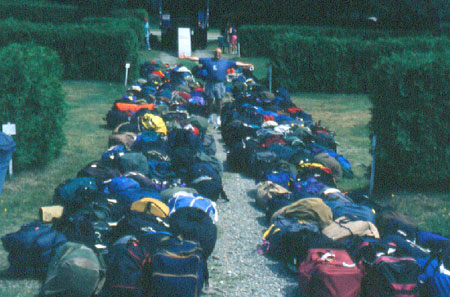
Help! Where is my duffel bag?
After setting up my tent and taking a shower, I walked to the small
Jackman library to send e-mail messages to my friends around the world.
At a grocery store I bought some Powerade to quench my thirst and a
Panda Bar to satisfy my hunger. A Panda Bar is a three-inch cube of
vanilla ice cream with a thin milk chocolate coating. As I indulged
in that delicious snack I chatted with Betty, a middle-aged woman from
Iowa whom I had met on a three-week bicycle tour from Santa Fe, New
Mexico to New Franklin, Missouri.
The following morning a steep hill was awaiting me just outside of Jackman.
I climbed it slowly and proceeded northward along Route 201. I was in
the lead position of all the MOOSA riders until two "Speedy González"
folks caught up with me and zoomed by like bats out of hell. My knees
hurt a bit because the day before I had pushed my pedals too hard in
a high gear. I rode for 15 miles to the Canadian border where I entered
the province of "la belle Québec."
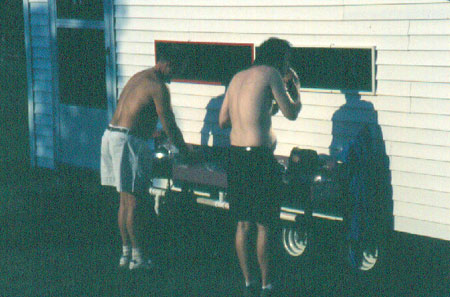
Washing up in the morning
For
several hours I followed Highway 173 to St. Georges where I crossed
the Chaudière River that flows through the plains of Québec.
Along the way I enjoyed magnificent panoramic views. Suzanne, another
MOOSA rider, soon caught up to me. We cycled together for 25 miles until
we came to the town of St. Joseph de Beauce where we camped with our
group.
The following day I biked alone to Lévis located on the southern
bank of the St. Lawrence River, across from Québec City. Just
before noon I reached the campus of Cégep de Lévis-Lauzon,
a technical college of about 3,600 students. My group would camp three
days beside the college's Sports Center, which was an ideal location
because the shower and toilet facilities were excellent. Also, nearby
was a large shopping center with a grocery store. All MOOSA riders are
responsible for providing their own meals. Usually I bought food and
prepared my own meals such as cold cereal with milk for breakfast and
sandwiches for lunch and supper. Occasionally I ate out with my fellow
cyclists.
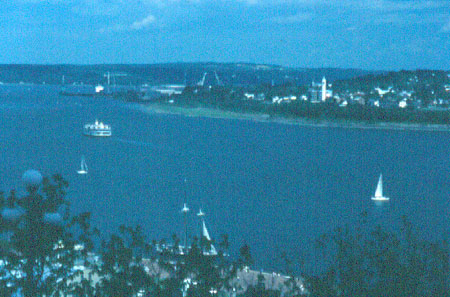
The St. Lawrence River
I was glad that I had arrived early at the campground, well ahead of
most of the other riders. I had first choice for my campsite, and there
was still plenty of hot water in the showers. My motto for this bicycle
tour was: "The early bird catches the worm." I did not like
rushing to camp to beat the crowd and, for this reason, I began to dislike
traveling with large groups of cyclists. My preference is to cycle tour
either alone or with just a few people.
In the evening I walked with a small group to downtown Lévis
where we ate at a Vietnamese restaurant. Our waiter spoke only Vietnamese
and French but because I read and speak French, I could translate the
menu for my friends and order what they wanted to eat and drink.
The following morning everyone made preparations for the day. Some riders
wished to explore historic Québec City, others planned to cycle
around the Isle of Orléans, and some folks wanted to simply relax
in camp.
I had other plans. Several years prior to the MOOSA Tour, I met Nicole
in Athens, Greece. Nicole is a middle-aged woman who lives in Québec
City. We both were traveling independently on separate around-the-world
trips. We became friends quickly and since then we have maintained our
friendship by writing letters. Nicole was surprised when I telephoned
her to say that I was camping just across the river in Lévis.
"Jim, what a pleasant surprise!" she said. "Look, I have
an apartment in my basement where you can stay. I'd like to show you
around my city. I can pick you up in an hour."
It was a wonderful, unexpected invitation. It took me only fifteen minutes
to take down my tent and pack my gear. When Nicole arrived, I threw
my duffel bags into the trunk of her car, secured my bicycle on her
bike rack, and off we went to her home in Charlesbourg, a suburb of
Québec City.
After dropping off my stuff there, we drove to downtown Québec,
a city of 700,000 people. The town derives its name from an Indian camp
called Kebec, an Algonquin word meaning "where the river narrows."
This reference is to the narrow point in the St. Lawrence River where
the first French explorers, fur trappers, and missionaries established
the colony of New France in the 17th century.
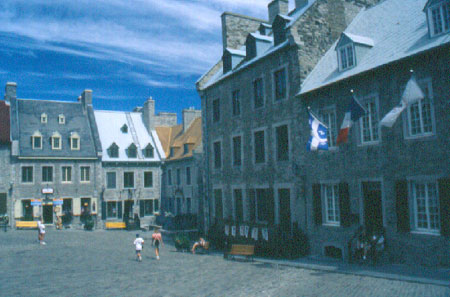
Old Québec City
Nicole took me on a walking tour of Québec, beginning with the
Lower City. We strolled along its main promenade that is lined with
dozens of gift shops full of tourist souvenirs and antiques.
We took a cable car from the Lower City to the Upper City where Nicole
lived as a young girl. We walked through a huge park called the Plains
of Abraham where a decisive battle took place in 1759. In that place
the British forces under General James Wolfe defeated the French army
commanded by the Marquis de Montcalm. Wolfe's victory marked the end
of French rule over Canada and the beginning of British rule.
Nicole and I stopped for lunch at a local cafe where I ordered a glass
of lemonade and a croque monsieur or "crunchy sir" (grilled
sandwich with ham and Swiss cheese). For dessert we each bought a queque
de castor or "beaver tail," which is a hot pastry in the shape
of a beaver's tail. Mine contained an apple filling and was sprinkled
with cinnamon on top. Delicious!
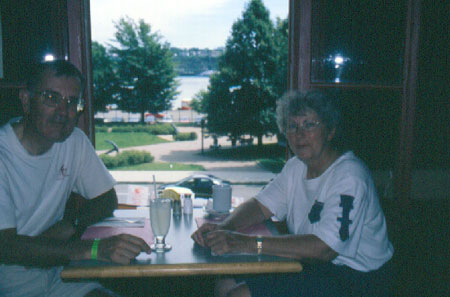
Nicole and I take a break at a cafe.
Our walking tour ended at Québec City's most celebrated landmark,
the Château Frontenac which overlooks the St. Lawrence River.
The Château was named after the Comte de Frontenac, governor of
the French colony between 1672 and 1698. Originally the Château
served as the administrative and military headquarters of New France.
Today it is an elegant hotel with many exclusive shops, an excellent
restaurant, an inviting bar, and a 700-seat ballroom reminiscent of
the Hall of Mirrors in Versailles, France.
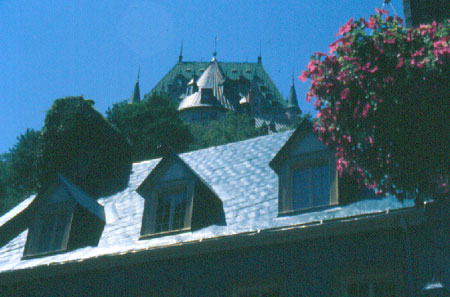
Château Frontenac
I slept soundly that evening because I was exhausted from my walking
tour in Québec City. In the morning Nicole and I drove downtown
where she dropped me off for sightseeing, then went to have her hair
cut at a beauty shop. I walked around town for several hours, visiting
some gift shops and snapping many photographs. Luckily, there was an
annual festival in progress called "Les Fêtes de la Nouvelle
France" or Festival of New France. I attended a ceremony in which
Native Canadians from different tribes danced to the loud beat of homemade
drums. To me it was an interesting, colorful performance but for the
participants it was a serious religious ritual.
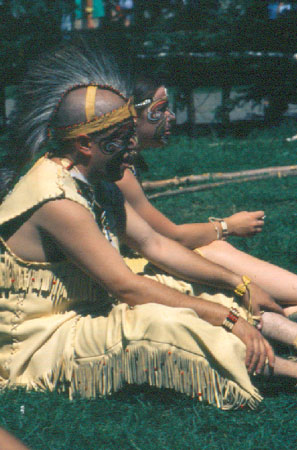
Two spectators at Les Fêtes de la Nouvelle
France celebration
In the afternoon Nicole and I went to a pretty park in Québec
City where we attended a concert of ancient French Canadian music. Afterwards,
she took me out to an elegant restaurant opposite the Château
Frontenac. We dined on linguine with shrimp, washed down with a glass
of cold beer. Later I treated us both to my favorite French Canadian
dessert: queque de castor. As we munched on our beaver tails, we watched
magnificent fireworks from the terrace of the Château.
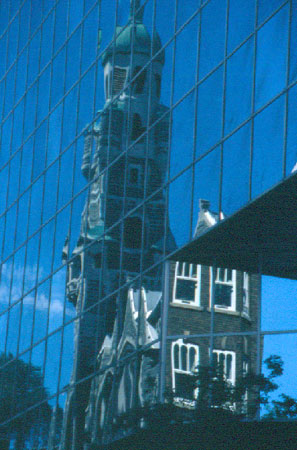
An old church reflected in a modern building in
Québec City
The following morning Nicole and I drove to Manoir Montmorency, the
former summer home of Sir Frederick Haldiman, governor of Canada in
the late 18th century. Today it is a sixty-four room inn with a restaurant
that offers a panoramic view of the St. Lawrence River.
We also visited nearby Montmorency Falls, one of the most beautiful
sights in Québec Province. At 274 feet the falls are 100 feet
higher than Niagara Falls, although they are far narrower than their
American counterpart. Visitors can view Montmorency Falls from high
up on a cliff or they can observe them from below by descending a long
flight of stairs. In winter the heavy spray of the falls freezes and
forms a giant loaf-shape ice cone called the Pain de Sucre or Sugarloaf.
Québec residents enjoy sledding and sliding down old Sugarloaf
during their leisure time.
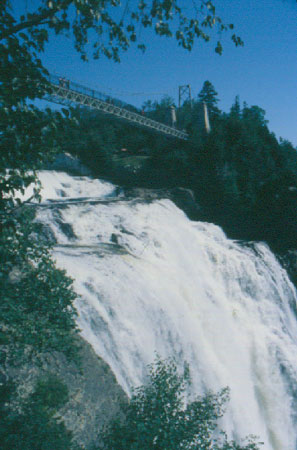
Montmorency Falls
Nicole and I crossed a bridge over the St. Lawrence River to the Île
d'Orléans, a beautiful island dotted with many farms. Located
just fifteen minutes by car from Québec City, the island is 21
miles long and only 5 miles wide. The Île d'Orléans is
a tranquil place whose rural beauty has long inspired poets and artists.
The six villages on the island have centuries-old homes and some of
the oldest churches in the region. I saw clusters of pretty flowers
decorating small courtyards, lush orchards bending under the weight
of apples, plums and pears, and fields bursting with strawberries and
raspberries. The Île d'Orléans is a virtual Garden of Eden!
All good things must come to an end, and so did my wonderful visit with
Nicole. After a lunch of trout that she had caught near her cottage
in northern Québec Province, she drove me to the Lévis
campground via a short ferry ride across the St. Lawrence River.
I set up my tent and chatted with my friends about how we had spent
the past three days. In the evening the MOOSA helpers loaded all the
bikes into two large rented trucks.
The following morning four motorcoaches arrived to drive us back to
Skowhegan where we had begun our MOOSA tour. As I sat in the front seat
of the first bus I thought about the wonderful time I had, the good
friends I made along the way, and the knowledge that I had gained on
Maine's Original Outstanding Super Adventure.
|