|
Northern
Europe
Arrival
in Holland
After breezing through immigration and customs at the Schiphol Airport
in Amsterdam, Holland, I saw my Israeli friend, David, who was waiting
for me in the passenger reception area. We greeted each other in Hebrew:
"Shalom!" (Hello).
Six years ago, David and I had cycled together with a small group from
Missoula, Montana to Anchorage, Alaska. Now, in early June, we would
begin another bicycle adventure northward, this time on a different
continent.
A fairly good night's sleep in a nearby campground at Amstelveen whisked
away my jet lag. As David and I ate breakfast and took down our tents,
a chorus of birds entertained us with their morning songs. That harmonious
scene contrasted with the horrendous racket that some German teenage
boys made during a drinking bout in the middle of the night. While they
slept comfortably in their drunken bliss, I wanted to stand by their
tents and scream in revenge. They probably would not have heard me.
David and I left Amstelveen on our fully-loaded bikes, heading first
in a westward direction to Haarlem, then northwest to a campground in
Bakkum on the North Sea. Small green and white bicycle signs marked
our route so well that we found our way around the Netherlands by using
only a rudimentary map of the country and a tiny two-dollar compass.
These signs pointed the way over bike paths and low-traffic roads that
led across farmlands, over dikes, through forests, and beside major
highways.
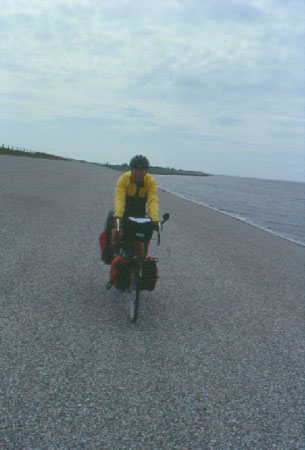
My bike and I along a Dutch dike
Unfortunately, the weather was not as predictable as the bicycle signs.
Sometimes the wind blasted our faces, which would be fine if we were
Dutch windmills. On other occasions the wind blew at our backs, pushing
us forward so fast that we pedaled almost effortlessly on pavement flat
as a pancake.
Miraculously, we encountered no wind at all as we cycled over the famous
Afsluitdijk, a 19-mile dike with the Waddenzee on our left and the Ijsselmeer
on our right. Midway across the dike, however, swarms of tiny black
flies attacked us. Some of those pests weaseled through the air vents
in my helmet and embedded themselves in my hair. I brushed them out
when I reached the other side of the dike in a province called Friesland.
We stopped in the town of Harlingen to buy food at a grocery store.
While eating my lunch of croissants and cheese, I saw a large semi-truck
smash into a railroad crossing sign, twisting it like a pretzel. Fortunately,
no one was hurt. I thought about how easily and quickly an accident
can occur, and what disastrous results it can render. The incident reminded
me of the importance of cycling defensively.
Near Bergum we stopped at a campground located on an old farm. The elderly
couple who owned and managed the place was friendly and helpful. They
welcomed us with smiles and handshakes, they looked after our basic
needs of a hot shower and food, and they rented us a clean grassy campsite
for about $7 US each.
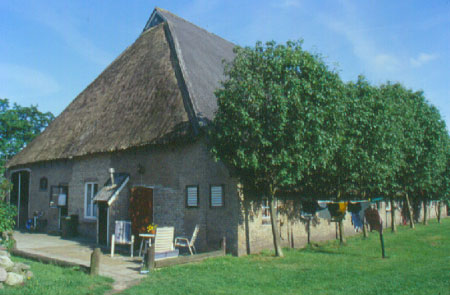
The old farmhouse near Bergum, Holland
I liked the villages and small towns of the Netherlands so I avoided
the large noisy cities like Groningen. "Don't go there," an
elderly gentleman warned us. "Lots of junkies live in Groningen."
David and I decided to skirt that city from the south, following an
excellent bike path that took us to the charming town of Leek. Just
as we were leaving, the rear rack on David's bike suddenly broke, and
his rear panniers tumbled to the ground.
Fortunately, nearly every town in Holland has a bicycle shop and Leek
no was exception. We bungeed the broken rack and the panniers to the
frame of the bike, then we returned to town where we easily found a
bike shop. The mechanic there repaired the rack with several strong
brackets and installed a stem extension on David's mountain bike that
was too short for his 6-foot height. In the meantime, David and I enjoyed
lunch at a nearby snack bar. Of course, I couldn't resist taking a leak
in Leek just so I could say that I did.
After spending the night at a campground in Zeegse, we pedaled eastward
but we went a bit too far south and arrived in Stadskanaal. We rested
there and had a snack beside a man-made canal that paralleled the town's
main street. Afterwards, we headed to the northeast and soon entered
the Federal Republic of Germany at Wymeer Dig.
Wilkommen
in Deutschland!
Although I had only a hostel map of Germany, I used my cheap compass
and sense of direction to find my way about that country. Maps are expensive
in Europe but, as in the Netherlands, small bicycle signs marked our
route so well that we didn't need a detailed map. Besides, we were just
going to cross a small corner of Northern Germany. "Why throw away
money by buying a map?" I asked David rhetorically.
I was the unofficial navigator on this bicycle trip, mainly because
David left that responsibility to me. My riding pace was much faster
than his; therefore, I waited for him many times. He also had numerous
mechanical problems such as a broken rack, an ill-fitting stem, and
many flat tires. After a week on the road, these unpleasant realities
began to tax my patience. A long adventurous trip with friends often
brings out the best and worst in them.
We camped just outside of Leer. The temperature was chilly that morning,
it rained in the early afternoon, but later the sun came out. As we
were going to bed at eight o'clock, a fearsome thunderstorm began to
rack the land and would not let us sleep.
The next morning David's handlebar slipped continuously in the new stem
extension that he had just bought in Leek. He struggled to keep up with
me as we cycled over a bike path strewn with thousands of twigs and
branches that had broken off trees during the storm. Patiently, I stopped
and waited for him again and again.
We stopped at a gas station where an attendant used a large wrench to
unloosen the head nut on David's bike. We pulled out the stem extension
and replaced the handlebars, resulting in the same configuration that
David had at the beginning of our trip. Although he was somewhat happier,
he was eager to find a bicycle shop where he could buy a stem of suitable
length.
After camping in Nordenham, we biked to Kleinsiel and took a ferry across
the Weser River to the village of Dedesdorf. From there we pedaled seven
miles northward to Bramerhaven. David noticed a small store on our left.
"Let's stop at that bike shop," he shouted. "I want to
buy a new stem and a front fender."
David bought not only a stem and a fender, but also a rear rack that
he tried to install himself. Unfortunately, he is less mechanically-inclined
than I am -- which isn't much. After struggling for three and one-half
hours to install the rack, David decided to put on the old one with
my help.
"This new rack doesn't fit my bike. I'm going to get my money back,"
he said.
My patience was nearly gone.
David loaded his panniers and camping gear onto his bike. Just as he
was finishing this task, the bike shop mechanic entered the store. David's
eyes opened wide with excitement. Instantly, he unloaded his gear and
asked the mechanic to install the rear rack.
The young man inspected the rack carefully and said, "Your rack
is okay. I would not buy a new one."
I was flabbergasted -- and frustrated. I had waited many hours for nothing.
David asked the mechanic to install the front fender and the stem on
his bike, which would take an hour. That was the straw that broke the
camel's back.
"I'm not waiting for you anymore, David. I've been waiting all
morning for you, and for nothing. I'm leaving," I told him.
"Okay, Jim. You go your way, and I'll go mine. I'll phone you when
you get home," he said.
In all honesty there was little animosity between us; rather, we simply
had a mutual agreement. We both said, "Shalom, shalom" (Good-bye).
Then I left.
As I rode through Bramerhaven, I felt a mixture of frustration, sadness,
anger, and guilt. I got lost several times partly because of my anxious
state of mind and partly because I was physically tired. Soon I arrived
at Bad Baderkesa where I settled in for the night at a campground. I
fell asleep wondering about where David was sleeping and how he would
manage on his own. He was no longer my biking partner but he still was
my friend.
My stop at the bike store in Bramerhaven was not completely futile.
I bought a pair of high-quality bicycle shorts there at a 60% discount.
Also, the salesman jotted down the names of the towns that I would pass
through as I cycled through Northern Germany toward Denmark. As a result,
I pedaled through Caxhaven, took the ferry across the Elbe River from
Wischhaven to Glückstadt, and stopped for lunch at a small grocery
store in St. Margareth.
I was cycling in the relatively flat region of Schleswig-Holstein where
I saw many Holstein cows grazing in lovely green pastures. Some of them
stopped chewing their cud and gawked at me, a total stranger in their
grassy homeland. In contrast to this bucolic scene, I saw several nuclear
plants with their ugly heads raised high above the gentle landscape.
Many times I looked into my rearview mirror, hoping to catch a glimpse
of David, plodding slowly along as he always did when we biked together.
In spite of our many differences, I missed his company.
Soon I reached Heide in a downpour. I wanted to camp in the area but
there was no campground nearby. A tiny triangle on my map indicated,
however, that there was a hostel in Heide. I found it easily in a large
gray stone building in the center of town.
I liked the clean, well-organized hostel immediately so I decided to
spend the night there. The kind middle-aged manager rented me a small
room on the second floor. It had a comfortable bunk bed, a small table
with a lamp, a wooden closet, a heat radiator, and a sink with hot and
cold running water -- all for only $14 US with breakfast included.
I showered in the men's bathroom across the hall and took a restful
nap as the rain outside came down in torrents. An hour later, two large
groups of screaming school children woke me from a deep sleep as they
were returning from a field trip with their teachers. That evening I
joined them for supper at a separate table in the dining room.
In the morning I left Heide in the rain and followed bike paths most
of the time. In a few places, however, there was no alternative but
to pedal along busy highways. I had two flat tires caused by tiny pieces
of quartz that penetrated the Kevlar coating of the tires and punctured
the tubes. It appeared that the force of raindrops loosened the quartz
crystals that had become embedded in my tires.
I stopped in Niebüll where I thought about staying at the hostel.
Unfortunately, it would not open for over an hour, so I had a snack,
then continued pedaling northward. Soon I arrived at the border between
Germany and Denmark where a Danish guard asked to see my passport. This
was an unusual request because for many years I saw no formalities at
all when crossing from one European country into another. In fact, normally
no guards are stationed at those borders; there is only a sign announcing
the name of the country that one is entering.
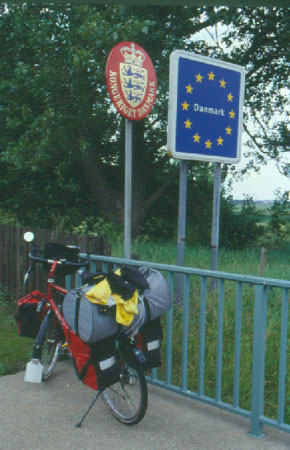
At the Danish border
Welcome
to Denmark!
In the late afternoon I arrived in Tønder where I found a small
clean campground. The manager sold me a mandatory camping pass for use
in Danish public and private campgrounds. He told me that all campgrounds
in Denmark have a TV lounge. He was correct but I soon discovered that
all those TV lounges reek of thick cigarette smoke.
Near my campsite I met Mats and Martin, two young Swedish cousins who
were cycling from Sweden to Gibraltar. I seldom met other long distance
tour cyclists on this trip, so it was a pleasure to chat with the fellows.
I told them that David was on his way north, and requested that if they
saw him on the road, would they please inform him that I was camping
in Tønder? They agreed to do so.
In the morning I washed my clothes and patched two tubes. Then I went
sightseeing in Tønder, an historic town of 15,000 people. I enjoyed
walking on the curving cobblestone streets lined with rustic half-timbered
houses that wealthy lace merchants had built in the 18th century. I
especially liked the Late Gothic Christ Church that dates back to the
late 16th century. The church has a 150-foot high tower that doubled
as a navigational marker when Tønder was connected to the North
Sea.
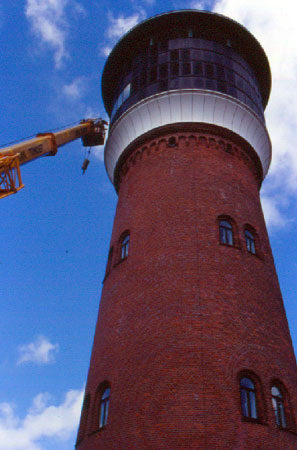
The church tower in Tønder, Denmark
While I was returning to camp, I discovered that I had misplaced my
sunglasses somewhere in town. I retraced my steps to no avail. I went
to the tourist office and to the police department but no one had turned
in any sunglasses at either of those places. I had no choice but to
buy a flimsy pair of clip-on sunglasses for $21 US.
A surprise was waiting for me at my campsite: David was standing in
front of my tent! We greeted each other like long-lost friends: "Shalom!"
I thought that the Swedish cousins had met David on the road and told
him where I was staying.
"No, I just decided to camp in Tønder," he said. "I
had more bike trouble since I left Bramerhaven, but now everything is
okay," he added.
David and I decided to travel together once again. We left Tønder
in the rain and pedaled along the North Sea. A strong headwind hindered
our efforts so we progressed slowly. To make matters worse, we each
had a flat in our front tires.
Soon the wind changed direction and began blowing at our backs. As we
entered Highway 11, we encountered very heavy motor traffic and there
was no shoulder to bike on. Trucks blew me off the road twice, which
were frightening experiences. I would have preferred to endure a strong
North Sea headwind rather than the constant whoosh of those passing
vehicles.
Finally, we reached a bike path and pedaled into Ribe. We found a pleasant
campground whose friendly manager rented us a campsite for two nights
so that David and I could relax and visit the town.
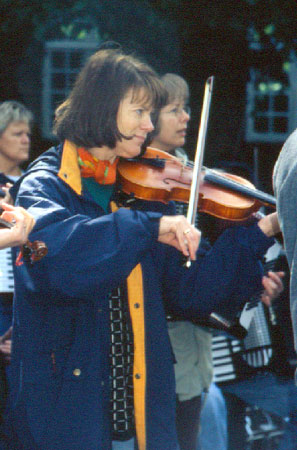
Small town concert
We walked around Ribe which has a population of 20,000 and is the oldest
town in Denmark. Founded in AD 700, Ribe has twisting lanes and cobbled
streets with more than one hundred 16th and 17th century half-timbered
houses. In the chimney of one of them I saw a stork's nest with several
birds in residence.
David wanted to buy a sturdy free-standing tent to replace his rather
flimsy one but no store in Ribe stocked such a tent. We decided to cycle
northeast to Kolding where he hoped to find a suitable tent. Two factors
were in our favor as we pedaled to that city: a sunny day and low traffic
because it was Sunday. After spinning our pedals for five hours, we
reached Kolding, then pushed on a bit farther and camped in Vonsild.
The next morning we went to the only two sports stores in Kolding. One
of the stores did not sell tents at all, and the other did not sell
free-standing tents. Mission ventured, mission failed. But David and
I had not made the side trip to Kolding entirely in vain. A knowledgeable
bike mechanic trued David's front wheel and adjusted my front and rear
brakes.
With our bicycles now in top shape, we headed north to Vejle where we
camped for two days. At the town library I received an e-mail message
from my nephew that my sister had just died of cancer at age 49. Because
I had expected that sad news sooner or later, my sister and I had said
our final good-byes before I left for Europe.
David found a large camping store in Vejle but he didn't like any of
their tents. Meanwhile, I replaced my fairly new tire with a spare.
From the beginning of the trip my old tire had a defective lump in it.
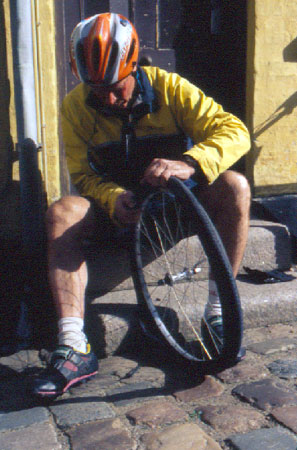
David repairs a blown tire in Ribe, Denmark
A fierce
wind howled all night and continued the next day. Once it even blew
me off my bicycle. David suffered even more when he took a very nasty
spill on his bike. Later in camp, a gust of wind pushed over my two-wheeler,
snapping the kickstand in half.
David and I bought a bicycle map of Denmark although we still managed
to get a bit off route occasionally. At least the map helped us avoid
busy highways jammed with motor vehicles. And it didn't rain the following
day. One must count one's blessings whenever and whenever they come
along.
We biked northward across the Danish countryside, following small signs
with a white bicycle against a blue background. The terrain became more
hilly with some long, steep hills that were heavily forested. I felt
like I was back home in the Pacific Northwest. Children were still attending
school so we had the bike paths and campgrounds mostly to ourselves.
But a campground manager warned us, "In two weeks many more people
will be on holiday."
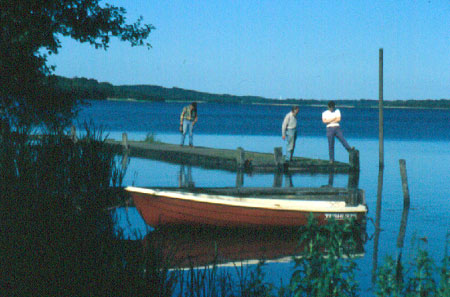
Danish boys at lakeside
We
continued our northward journey straight up the Jutland Peninsula of
Denmark. The Swedish cousins whom I had met in Tønder suggested
that I stay at a farm campground in Vammen. We reached that village
at noon just as David had a flat tire. The farm was located down a long
gravel road.
The owner's son, a blond-haired, freckled-face boy of eleven years showed
me to a campsite located on a large grassy terrace. The lad spoke English
haltingly but when I told him that I knew German, we continued our conversation
in that language.
In the evening David and I joined two German couples in a sing-along
around a campfire located inside a cozy lounge. The farm owner brought
his guitar, sat down with us, and began playing various songs. To my
surprise, David reluctantly sang a solo of "Good Night, Irene."
The next morning we followed a bike path that was partially paved and
partially graveled. We reached the city of Ålborg in the early
afternoon and camped near the beach on the Limfjord. The Strand-Parken
campground was very crowded with cabins, travel trailers, tents, and
all sorts of motor vehicles. Worse yet were crowds of campers in their
early 20s, many of whom were loud, boisterous, and drunk. I nicknamed
them "the beach boys and the beach girls."
"Let's camp here just for tonight, then leave early in the morning,"
I suggested to David. He agreed.
At sack time I inserted my ear plugs to dull the drunken din about me.
I also donned my sleeping mask to block out the bright sun that would
not set until midnight. Unfortunately, my sleep was interrupted many
times by the beach boys and the beach girls who talked loudly, screamed,
shouted, and hooted throughout the night as they drank, danced, and
careened in and around their tents.
David and I left Ålborg at seven o'clock in the morning as the
crowds of young campers slept off their hangovers. It was a sunny and
peaceful Sunday as we headed into the northernmost part of the Jutland
Peninsula. We pedaled through the small Danish villages of Tolne and
Kvissel, and stopped in Jerup to camp on the grounds of a sports center.
Best of all, we were the only campers there.
The next day, non-stop rain followed us to Skagen. David got a flat
on his rear tire. We stopped to change it, then we started again in
the rain. Several minutes later, he had another flat on the same tire.
When we stopped to change it, I noticed a broken spoke in my rear wheel.
Once again we headed out in the rain. Minutes later, I had a flat on
my rear tire. We stopped to change it, then we began cycling again in
the rain. Three miles south of Skagen, David had a flat on his front
tire. In every case, a small piece of quartz caused our flats that day.
David put on his new Tom Slick spare tire and inserted a tube which
suddenly burst when he pumped too much air into it. I loaned him one
of my patched tubes and off we went in the rain, soaked to the bone,
chilled to the bone marrow, with only one good spare tube between us.
As we limped our way into Skagen, I noticed a hostel on our right. I
imagined us warming our feet in front of a cozy fireplace and sipping
a cup of hot chocolate.
"I'm sorry but we're full," the hostel manager told us when
we inquired about staying there. Well, I don't like hot chocolate that
much anyway.
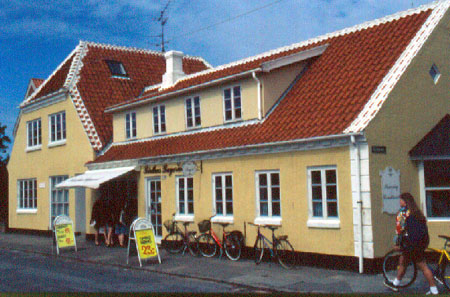
A supermarket in Skagen, Denmark
Our
luck improved when we found a crowded but accommodating campground in
Skagen. Although the campsites were as soaked as we were, there was
a dry, smoky TV lounge where we could eat the delicious chicken sandwiches
that we had bought at a bakery in town. In addition, we dropped off
our bicycles at a shop where we bought new tubes, tires, and had a new
rear wheel built for my bike. One must count one's blessings wherever
and whenever they come along.
The next morning David and I walked into town to pick up our repaired
bicycles. A woman almost ran over me with her two wheeler as I treaded
unwittingly in her bike path. Later, my biking partner and I rode out
to Gremen, Denmark's northernmost point where the waters of the Kattegat
and Skagerrak clash.
In the evening we attended a summer solstice festival during which thousands
of local citizens and visitors gathered to listen to a jazz concert,
drink beer, socialize, and gaze at a huge spectacular bonfire. For David
and me that festivity was a fitting celebration of our long bicycle
ride from Amsterdam. But our trip was not over; we would continue traveling
north the following morning.
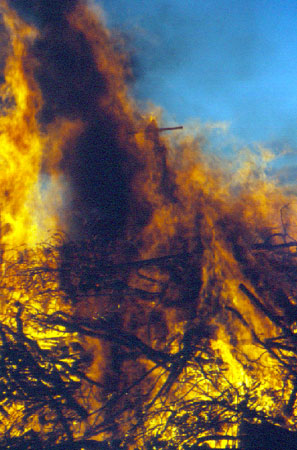
Summer solstice festival in Skagen, Denmark
Norway
at last!
We boarded a fast, luxurious ferry from Skagen to Larvik, Norway where
the anthropologist Thor Heyerdahl was born. We camped in a large area
that looked like a fairground. Nearby was a go-kart race track and a
large, modern shopping mall. I was impressed with the cleanliness of
Norway, but its very high prices for almost everything appalled me.
Just as David and I had finished eating supper, a kind woman at our
campground offered us each a plate of salmon, leek, and salad. We graciously
accepted her kind gesture and somehow we managed to gulp down all that
food. We were like stuffed pigs at a farmer's market.
The next morning we cycled five miles south of Larvik to the seaside
resort of Stavern. From there we pedaled to a charming hamlet called
Nevlunghama, then continued on to the small fishing port of Helgeroa.
Because camping fees were so high in that area, we returned to spend
the night at our campground in Larvik.
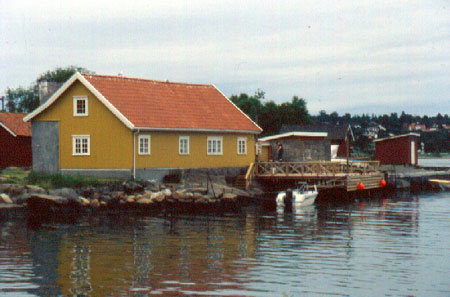
A small fishing port: Nevlunghama, Norway
In
the morning I woke up to a flat tire on my bicycle. Some may say that
was an evil omen for upcoming events. We headed north in the rain up
very steep mountainous highways often crowded with speeding motor vehicles.
At one point we walked our bikes over a fragile bridge above a swiftly-flowing
river, then cycled along a bike path until it ended at the entrance
to a freeway. Although a sign there clearly stated that bicycles were
forbidden on that busy highway, we saw no alternative road to cycle
over.
We reached Drammen without being arrested and pedaled to a campground
where we could finally relax. Later, two huge vans pulling trailers
arrived carrying a troop of blonde teenage girls and their teachers
who pitched a huge, circus-like tent near mine. David and I moved our
tents to another campsite and relaxed once again. For both of us it
had been a tough, unnerving day.
I was becoming increasingly frustrated with David's dependency on my
ability to navigate during our entire bicycle trip. So the next day
I asked him to take the lead as I followed behind him. Within minutes
he led us the wrong way by paying no attention to signs and exhibiting
no sense of direction. As a result, we got lost many times.
I thought that strategy would teach David a lesson but he learned nothing.
As we approached Oslo, he stopped to ask directions from a police officer.
The man responded in excellent English, "Go straight ahead to that
crossroads and turn right. Follow the bike path along the main highway
all the way to Oslo."
After listening carefully to these directions, David pedaled to the
crossroads and continued straight up a steep hill where he promptly
lost me. He forgot what the policeman had told him and he assumed that
I was following closely behind him. Fortunately, I eventually caught
up with David and stated firmly, "Follow me!" He relinquished
his leadership immediately.
We pedaled into downtown Oslo, then to Ekeburg Camping where we paid
$20 per night per person -- an outrageous expense. That evening David
and I walked to a nearby sports arena where we saw hundreds of men and
women participating in a massive marching competition and waving Norwegian
flags. I have never witnessed such patriotism anywhere in the world.
It rained throughout the night and continued during the next day. David
and I left our bicycles in camp and took a bus to downtown Oslo. We
strolled around the main harbor area, then went by boat to the Bygdøy
peninsula where we visited two museums.
The Viking Ship Museum housed three oak ships used as tombs for nobility
in the 9th century. More fascinating was the Kon-Tiki Museum that displayed
Thor Heyerdahl's balsa raft on which he and his small crew sailed 4,300
miles from Peru to Polynesia in 1947. The adventurous voyage proved
that Polynesia's first settlers could have come from South America.
The museum also displayed many exhibits from Heyerdahl's visits to Easter
Island, as well as the papyrus reed boat "Ra II" in which
he crossed the Atlantic Ocean in 1970.
David and I left Oslo under a partly cloudy sky. We pedaled southwards
and followed a bike path along the Oslo Fjord. At one point a newspaper
reporter and her photographer assistant stopped us to do an interview
and to take our photograph for an article. We were surprised, flattered,
and delighted that they wanted to publicize our trip in their community.
They graciously promised to send a copy of the article to our homes.
In Moss I picked up some mail, and David had his cyclometer repaired.
Several hours later, we arrived in at Nes Camping in Jeyol. The manager
of the campground wanted $25 US per person to pitch a tent there. We
were shocked and asked about Norway's ancient law about camping for
free on private land.
"There is a place down there," he said, pointing to a beach
about one kilometer away. "You can camp there but remember that
I didn't tell you that," he added firmly.
"We didn't hear anything. Thank you," I said.
Our free campsite was wonderful. I pitched my tent next to an old cabin,
and David set his up on the other side. Next to the cabin was a functioning
water spigot. Many tall garbage cans were scattered around. An outhouse
stood nearby. The view of the Oslo Fjord was fantastic. And the sunset
was the "cherry on the cake." One must count one's blessings
wherever and whenever they come along.
During the night a group of Norwegian teenagers woke me up several times
when they yelled and shouted sentences and expletives that fortunately
I didn't understand. I dashed out of my tent to bring in my freshly-washed
jersey and cycling shorts so no one would steal them.
David and I left camp early in the morning. I began to have a problem
with my bicycle chain. Every time I pushed down my right pedal, I heard
a "click." I assumed that my chain needed adjustment or replacement.
South
to Sweden
It rained off and on during the day but by late afternoon it was sunny
and warm. After a great deal of difficulty finding our way, we reached
a border crossing, pedaled across a long bridge to Sweden, and turned
right into Svinesund's Camping. The price was right: it cost only $5
US per person to camp there. I began to love Sweden immediately. The
sun came out quite strongly to celebrate the happy occasion.
During the night the chilly temperature woke me up. I was wearing a
T-shirt and boxer shorts because my Patagonia underwear, which I had
hung in my tent, was still damp from washing. I put on the damp underwear,
pulled on a pair of socks, and donned a wool cap to warm up. Soon my
body heat dried the underwear, and I fell asleep again.
David and I biked to Strömstad as my chain continued to click on
each revolution. The bike shop there would not be open for another hour,
and the nearby campground was too expensive for our budget. Several
miles down the road we found a large campground called "Lagunen"
that sprawled on both sides of the road. I sweet-talked the manager
into renting David and me a campsite for $12.50 US.
After pitching our tents, we rode to the bike shop in Strömstad
where a mechanic replaced my chain and oiled my pedals. We looked around
the pretty resort town, then returned to camp and relaxed for the rest
of the day.
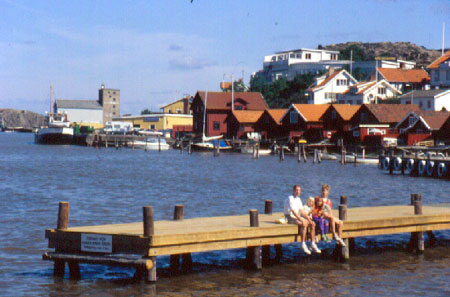
The seaside resort of Fjällbacka, Sweden
The
following morning David and I pedaled through the seaside resort of
Fjällbacka. The town has a beautiful harbor and a marina with all
sorts of recreational boats. Later, my biking partner and I camped near
Hamburgsund where the gorgeous, young and pregnant clerk charged us
only $4.50 each to camp. In her mini-market I noticed that the brandname
of the toilet paper was called "Kräpp," which gave us
quite a laugh. I couldn't resist taking close-up picture of David holding
a large roll of Kräpp in both hands.
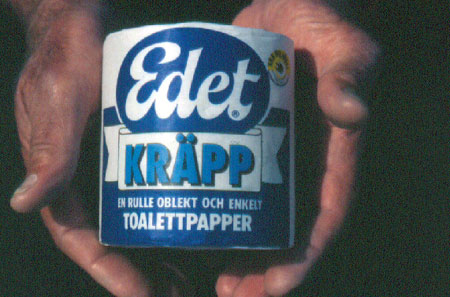
David holds a roll of Kräpp.
Near
Lysekil we took a small ferry to the pretty little fishing village of
Fiskebäckstil. From there we pedaled up and down hills on a narrow
road replete with heavy motor traffic. Even more frightening was walking
our bicycles through a lighted tunnel while hundreds of cars and trucks
zoomed by us only several feet from our fragile bodies. We crossed two
huge bridges and pedaled quickly through another tunnel. I whizzed through
it so fast that I didn't notice a bike path actually went around the
tunnel.
When we reached the town of Jörlanda, I saw David biking down the
wrong road. I pedaled quickly to catch up with him to set him straight.
I wondered what he would have done without my guidance. I disliked his
dependency on my navigational skills so much that I decided to give
him a test.
At the small town of Kode we came to a fork in the road. The correct
route was to proceed straight ahead and continue to Kareby. Now David
was the navigator. He looked at our map and said, "Let's turn right
here and go to Solberga."
We did so, and rode for nearly two miles until we came to an intersection.
Now David was faced with four choices: continue straight, turn right,
turn left, or retrace our route. While he looked at the map and pondered
the correct way, I cycled into Solberga and took a picture of its pretty
church. When I returned to the intersection, David was still trying
to determine our route. Suddenly, he said, "Let's go back to Kode.
I think we've come the wrong way."
We finally arrived in Kareby, then continued to Kungälv where stopped
at a McDonald's restaurant. David offered to treat me to a snack partially
to appease my ire and partially to celebrate the day: the Fourth of
July or Independence Day in the United States.
We camped near a hostel in the southern part of town. I managed to negotiate
a very reasonable price for both of us, with a free shower thrown in
the deal. So far it had been the best place we stayed on our bicycle
tour of Northern Europe.
We had breakfast on the terrace of the hostel which was built in 1881.
Afterwards, we headed south on a bike path that led us through the large
city of Göteborg. It was a quiet, peaceful Sunday except for a
strong wind that blew all day.
We decided to camp at the large and modern sports center in Kungsbacka.
The campground clerk there insisted that we have a Swedish camping pass,
and David volunteered to pay for it. The pass entitled him to receive
a free upgrade to a super size meal at McDonalds' restaurants in Sweden,
plus a free ice cream cone at each one. The clerk allowed us to pitch
our tents next to the main building so we would be sheltered from the
fierce wind that had prevented me from setting up my tent on the lawn.
David and I took the next day off to relax and look around Kungsbacka.
We each bought a new tire and installed it on our bikes. While David
was pumping up his tire, it burst with a loud explosion: too much air.
He also forgot his jacket at the bike shop after it closed for the day,
so we had to leave camp later the following morning.
As we cycled southward we enjoyed the sunshine, the relatively flat
terrain, and the splendid scenery. David tagged far behind me at times
so I stopped and waited for him as usual. We camped five miles south
of Falkenberg along the sea in a campground packed with small travel
trailers and hoards of tourists.
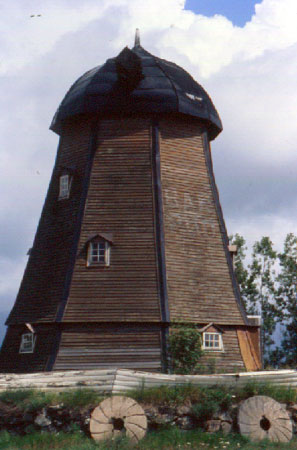
An old Swedish mill
We
pedaled southward along a busy road, then cycled over a bike path to
Båstad which was crowded with spectators attending a tennis match.
We left town and climbed an extremely steep and long hill, then eventually
reached Ängelholm. The campground there was located in a large
field just outside the city. We shared the camp with a father and his
12-year-old son who were also long distance cycle tourists. They were
originally from Croatia where they once owned three houses and an apartment.
"We were rich then but now I have no job," the father lamented.
Nevertheless, both father and son seemed quite happy. The boy wore an
interesting baseball camp with a small propeller attached to the brim;
it was operated by solar energy.
"Propeller cools face," the boy said in broken English.
David and I ate supper at our favorite restaurant: McDonald's. We both
ordered a McAroni that consisted of a light-weight cardboard bowl filled
with lettuce, bacon, chicken and, of course, macaroni. It was a perfect
meal for a bicyclist.
That evening a full moon rose over the campground which was a quiet,
tranquil place to spend the night. Sweden was my favorite country on
this tour. I vowed to return there someday.
In the morning David and I cycled southwestward over the flat Swedish
countryside. As we approached Helsingborg, David didn't see me waiting
for him at a traffic circle. Rather than turning left, he turned right
and vanished quickly from my sight. I pushed down very hard on my pedals
to try catching up with him, but he was gone. When I reached downtown
Helsingborg, there was David riding his bicycle.
"I thought you took the ferry to Denmark," he said with a
surprised look on his face.
We boarded a ferry with many Swedish men who had brought abroad hundreds
of cases containing empty beer bottles. The men were going to buy more
beer in Denmark where it is much cheaper than in Sweden. In fact, that
informal import-export business was their livelihood.
Back
to Denmark
David and I disembarked at Helsingør, then pedaled southwestward
to Hillerød. Just outside of town I saw a series of camping signs
that led us through vast gardens and right up to a huge castle. We reached
Hillerød Camping where we pitched our tents in the soggy soil
due to recent heavy rain.
We stayed an extra day in Hillerød to visit Frederiksborg Castle,
most of which was built in the 17th century by Frederik II's son, King
Christian IV. The Danish Renaissance castle, which spreads over three
islets, has a magnificent courtyard with an ornate Neptune fountain.
The interior boasts guilded ceilings, wall-sized tapestries, as well
as many fine paintings and antiques.
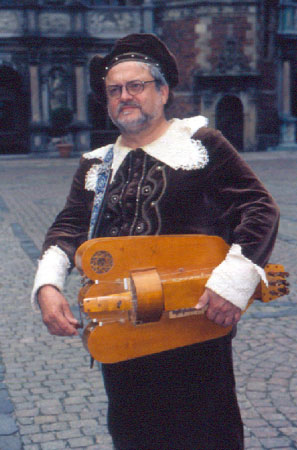
A wandering minstrel at Frederiksborg Castle
Many
motorists honked their horns at David and me as we headed southwest
on Highway 6. Apparently no bicycles were allowed on the road, but we
saw no other alternative. Soon we turned off that busy highway and reached
Frederikssund. We had just crossed a bridge there when it opened to
allow a large boat to pass. In Skibby we stopped at a bike shop for
some minor repairs on our bicycle, and shopped for groceries in
Tølløse, then camped nearby.
During the night a young couple near my tent laughed and giggled for
over an hour in their tent. Desperately wanting to sleep, I screamed,
"Shut up!" The couple continued to talk loudly among themselves
and laughed repeatedly. The woman had an almost uncontrollable loud
laugh that irritated me. Again I shouted, "Shut up!" My efforts
were rewarded instantly: the inconsiderate couple fell silent, and eventually
we all fell asleep.
It was a pleasure to leave that campground and pedal past long fields
of wheat and meadows filled with pretty wildflowers all the way to Sorø.
From there David and I continued to Slagelse, and finally to Korsør.
My biking partner lagged far behind me as usual, so I waited for him
many times.
A bus carried us across the new Great Belt Bridge while our bicycles
rode behind us in a trailer shaped like a giant silver cylinder. The
elegant 11-mile bridge, which reminded me of the Golden Gate Bridge
in San Francisco, links the islands of Sjælland and Fyn.
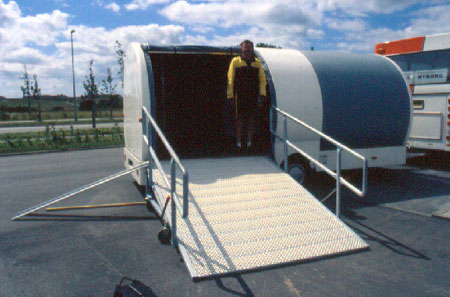
The giant cylinder-like trailer for bikes
We
pedaled southward from Nyborg and stopped at a picturesque rest area.
Suddenly, David's front tire exploded, perhaps because he had placed
his bike on a very steep slant against a low, wooden fence. He fixed
the flat by installing a tube about whose condition he was not certain.
A few miles down the road, the same tire went flat, and David wisely
inserted a new tube.
We camped for the night at a converted farm near Tårup. The bathroom
and shower facilities were new; in fact, they were the best that we
had encountered on our trip.
It was raining and windy when we broke camp the next morning. The headwind
continued blowing fiercely all day, sometimes in gigantic gusts that
seriously slowed our progress toward Bøjden. To make matters
worse, David had a flat tire and changed it in that miserable weather.
We took the 45-minute ferry to Fynshavn and biked into a headwind to
Augustenborg where we decided to camp. We pitched our tents beside an
old trailer sheltered from the wind by two rows of 7-foot high hedges,
and made the best of our unpleasant situation.
The next day was the most miserable one on our entire trip. I ate breakfast
in my tent because it was raining outside. David ate his breakfast in
the smelly campground kitchen whose floor was strewn with large old
bones.
As we pedaled slowly toward the German border, the wind and rain blasted
our faces and nearly blew us off our bicycles. David had a flat tire
on his rear wheel. He repaired the flat, then stopped again to center
the wheel. This process took over a half hour. I was becoming quite
tired, impatient, and frustrated. David's rear tire began leaking slowly,
so he stopped several times to pump it up, rather than to repair it.
He was desperate to reach a bike shop.
Back
in Germany
Finally, we crossed into Germany and entered the city of Flensberg.
We visited the tourist information office where I inquired about the
location of the nearest bike shop while David waited outside to keep
an eye on our two-wheelers and gear.
As we walked our bicycles toward the shop, David asked, "Did you
ask what the weather will be like tomorrow?"
"No! We're going to the bike shop. That's more important right
now. Who cares about the weather for tomorrow? What a stupid question,"
I said angrily.
"It's not a stupid question," David insisted.
Suddenly, my pent-up impatience exploded like one of David's overinflated
tires. I was angered by the frustration of waiting for him on the road,
coping with his dependency on my navigational skills, and being patient
with his many bicycle repairs.
"It IS a stupid question. Shut up!" I yelled as I began walking
away from him.
"Shut up!" David barked back, proceeding in another direction
toward the bike shop.
Then and there I decided to take my leave of one of the most irresponsible
and inconsiderate persons that I have ever met. I wanted complete freedom
from him. I wanted to be alone.
"That's it! I'm biking on my own! Good-bye! I shouted.
"Good-bye!" David said.
And that was that.
I left Flensberg and began pedaling south toward Husum. In spite of
the continued rain and wind, I felt greatly relieved to be on my own.
Suddenly, I thought, "Why do I need to go to Husum today in this
miserable weather? There must be a campground in Flensberg."
I turned around and cycled back to Flensberg in massive gusts of wind
and rain. Eventually, I found a campground on the edge of the city.
I pitched my tent in front of a row of tall bushes that formed a living
barrier blocking much of the wind. An old travel trailer next to my
tent provided additional protection. As the maelstrom raged outside
my humble canvas abode, I calmed my nerves by meditating, and soon I
fell into a deep sleep.
Epilogue
Rather than continue my bicycle trip back to Amsterdam where it began,
I decided to visit friends in Germany. After all, now I was fully independent
and had no need to consult anyone about anything. I was free!
I took a train to Guben, a small town on the German-Polish border. There
I stayed several days with Elke, a friend whom I had met in the Cook
Islands. I also took some all-day bicycle tours in Poland with her brother
who was an avid bicyclist. In addition, I celebrated my birthday with
Elke's family and visited Berlin several times by train.
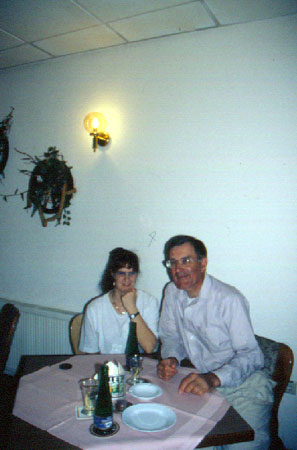
Elke and me at her parent's apartment
I took
another train to Sersheim, a small village in Southern Germany. I visited
my friend, Manfred, whom I had met on Easter Island. Now he was married
and a father of three young children. We went on several short bicycle
rides and took a road trip to visit the famous Black
Forest.
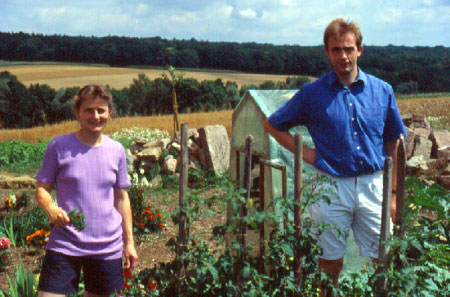
Manfred and his wife, Birgit
A week
later, I returned by train to Amsterdam from where I had planned to
fly back to the United States. I rode my bicycle to the same campground
in Amstelveen where David and I had begun our trip. While registering
at the reception desk, the clerk had a message for me.
"An Israeli guy has been looking for you," he said.
Instantly, I knew he was referring to David. "Is he here?"
I asked excitedly.
"Yes, he's camped in this area," the young man said, pointing
to the place on a large map of the campground.
David knew the date of my return flight to the United States, so I was
surprised but not shocked that he was camping at Amstelveen. He assumed
correctly that I would stay there the night before I left Europe for
home.
I pedaled to the area of David's campsite. As I was describing him to
several campers, suddenly one of them blurted out, "There he is!"
And there was David. He was walking back to his tent from the restroom.
I approached him quietly as he was eating a snack on the lawn.
"Shalom!" I said with a smile.
"Shalom!" he answered with a surprised look on his face.
Once again we repaired our friendship beginning with that beautiful
Hebrew word: shalom (peace).
|