|
North
to Alaska!
Who
would be crazy enough to take a grueling 3,200-mile bicycle expedition
from Montana to Alaska for two and one-half months? Who would be nuts
enough to pay 2,600 US dollars to make such a difficult journey? And
who in their right mind would prepare for that trek by spending $3,000
more for a new mountain bike, new panniers, new tools, new spare parts,
new camping equipment, new cycling clothes, and a new camera?
Me! I would! I confess my insanity. In February 1994 I registered to
join Adventure Cycling Association's self-contained "North Star"
expedition. That was going to be my second extended bicycle tour.
Sixteen years prior to this trip I pedaled around pancake-flat Holland
for two weeks on a heavy no-gears Dutch bike that I rented from a train
station for $9 per week. I had strapped my loaded backpack to the rear
rack of the bicycle and stayed in youth hostels along the way.
My
bicycle rig
Now I was about to embark on a ten-week journey over high mountain passes
on a new 21-gear MB-2 Bridgestone bike that cost $900. This time I would
camp out during the entire expedition.
My mountain bike was heavily loaded with front and rear Ortlieb panniers
as well as a two-person Sierra Designs tent, a REI sleeping bag, and
a full-length Therm-A-Rest air mattress. When I first mounted this two-wheeled
pack mule in my driveway, I lost my balance and nearly fell off. However,
I took the rig on several shakedown rides around my hometown of Bellingham,
Washington and soon I became accustomed to riding it.
. 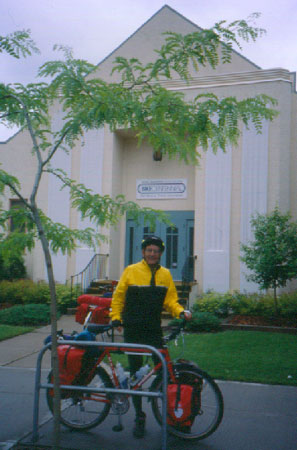
Me and my loaded bike
Bound
for Alaska
In early June I loaded my bike, my gear, and myself aboard a Greyhound
bus and rode all night to the North Star expedition trailhead in Missoula,
Montana. At that point there was no turning back. I was going north
to Alaska by bicycle!
In Missoula I met my group leader, Chuck Penegor, who was a relatively
large gentleman. I thought, "This fellow must be one hundred pounds
overweight. And he bikes in sandals! How in the world could this guy
lead our group over the rugged terrain in Alaska?"
First impressions are often deceiving. I soon learned that Chuck was
a highly capable leader who had gone on the North Star expedition for
the past four summers. His knowledge of the route, his experience in
bicycle touring and camping, plus his leadership skills, quickly earned
Chuck considerable respect among the other nine men and women in my
group. Besides, the fellow had a wonderful sense of humor. For instance,
he told me that while riding his bike, sometimes his protruding stomach
rests on his cyclometer and cancels it to zeros!
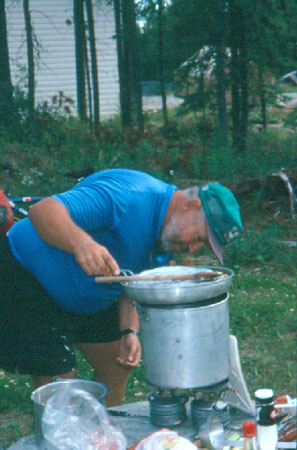
Chuck Penegor, our tour leader
Chuck
took our group on a 28-mile shakedown ride in a steady downpour. Afterwards
I dried myself off and got ready for more adventures.
And the next day I had some. Several huge motorhomes zoomed by me, nearly
clipping off my left panniers. I played "dodge-em" with gargantuan
road graders in a muddy construction area. When I ran out of low gears,
I dismounted my loaded rig and pushed it up several steep hills.
Going-to-the-Sun
Highway
After pedaling one week in the Rocky Mountains, my body was in much
better shape. I was ready to tackle one of the most difficult challenges
of the North Star expedition: the ascent to Logan Pass on the Going-to-the-Sun
Highway. This spectacular 52-mile highway in Glacier National Park crosses
the Continental Divide at 6,680 feet above sea level.
At first the highway was relatively flat, but soon it zigzagged up along
the side of a gigantic mountain. As I climbed higher, the road narrowed
considerably. Sometimes when I looked up, I saw the road snaking upward
and disappearing into the clouds. "Will I make it? Can I make it?"
I wondered.
As I pedaled higher and higher in my lowest gear, I sweated like an
elephant in labor. Occasionally, I stopped to catch my breath and to
gulp down water from one of my two water bottles. But I did so just
for a minute; I had to continue pedaling without lingering too long.
Cars and motorhomes edged slowly around me, forcing me to bike alongside
the low walls on the narrow road. I tried not to look down at the valley
below because I suffer from fear of heights. Once I glanced over the
side and peered down at the Swan River. It looked like a long, skinny
worm weaving its way along the valley floor far below me. I shuddered
and clenched my handlebars more tightly as my heart pounded rapidly
like a drumbeat at a pow-wow.
I continued pedaling uphill very slowly. My legs protested the strain
and screamed from the excruciating pain. Sweat streamed from every pore
in my body and dripped over my eyeglasses so I could barely see ahead.
I was determined to keep going forward. With every downward stroke of
my pedals I encouraged myself aloud: "You can make it, Jim! Keep
going! You're strong! You can do it! You'll get there! You paid your
money for this trip!" I was going to reach the summit of Logan
Pass if it killed me.
After three and one-half grueling hours, I finally made it to the top.
I was very tired but I was still alive.
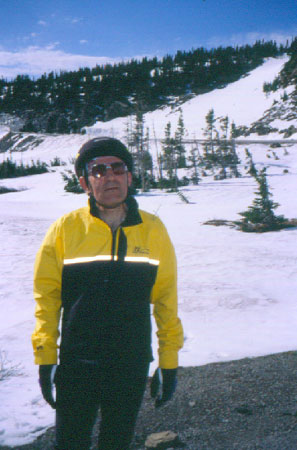
Logan Pass at last!
The ride down Logan Pass was just as breathtaking as the ascent up it.
Gravity grabbed my bike and yanked it downhill like a bobsled headed
toward hell. I held tightly onto my handlebars and zoomed down the highway.
The sides of the road blurred and my cyclometer whirred: 20...25...30...35
miles per hour. I was flirting with death on a mountain! I braked intermittently
to slow down. Luckily my cantilever brakes responded well and I reached
the base of the mountain safely. What a rush!
Daily
routine
Each day Chuck assigned two different group members who prepared supper.
Usually the meal included a pasta or rice dish, a mixed salad, and cookies
-- all washed down by a powdered juice drink. There was plenty of food
for everyone, and almost always we could help ourselves to a second
helping. During the expedition we consumed five or six times the amount
of food that we ate at home. Afterall, we cycled 6 to 8 hours per day
at an average daily distance of 55-60 miles.
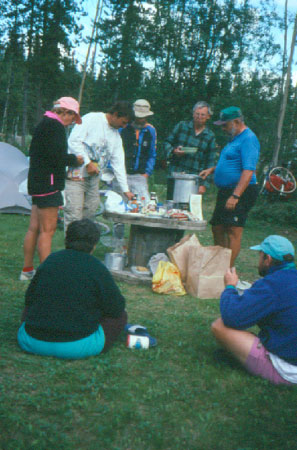
Supper!
Come and get it!
Breakfast
was more predictable than supper: instant oatmeal and dry cereal with
milk, orange juice, coffee, and hot chocolate. Nearly everyone in my
group ate a second breakfast at a roadside cafe where they ordered pancakes,
French toast, and eggs with sausage, bacon or ham. Not me! I paid my
$2,600 fee to join the North Star expedition, so naturally I stuffed
myself at breakfast in camp every morning.
Every 7-10 days my fellow cyclists and I rested one full day in a variety
of towns and parks in Canada and Alaska. On rest days we relaxed and
recharged our mental and corporal batteries. Each person did his or
her own thing: calling home, writing letters, washing clothes, cleaning
the bike, hiking trails, and shopping for souvenirs.
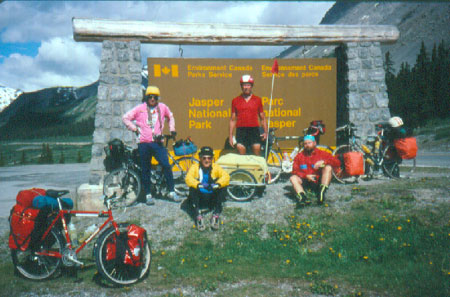
Arrival
at Jasper for a rest day
Expedition
difficulties
As my riding companions and I cycled northward toward Alaska, the physical
and emotional strain of the long expedition became increasingly apparent.
Tempers flared over minor human failings, and rage built up against
one group member who was treated like an outcast because he often failed
to consider the feelings of others. This rage peaked when that person
sat at a picnic table while another man was preparing supper. In an
instant two gallons of boiling water poured on that man's feet, causing
second-degree burns and his departure home to California.
Unfortunately, he was not the only group member we lost. Earlier, a
young fellow from Belgium dropped out of the expedition when he injured
his knees. He had come all the way from Belgium. After riding three
days in tremendous headwinds, another man decided to return home to
Oklahoma. "I've had it," he said with tears in his eyes. "I'm
tired and I miss my wife." A few weeks later another guy hit a
pothole on the Top of the World Highway in Alaska and broke his left
collar bone. The next day he was homeward bound to North Carolina.
I also had my own cross to bear. Before beginning the expedition, I
had purchased a Softride suspension stem to cushion my ride, especially
over hundreds of miles of gravel on the Robert Campbell Highway. The
stem was several inches too short and no bike shop on the North Star
route stocked an extension for it. As a result, my hands and wrists
hurt so much that my eyes often filled with tears, and I could not sleep
well at night.
Eventually, fate came to my rescue. While cycling over the Robert Campbell
Highway, several miners warned our group that five forest fires were
raging twenty miles ahead of us. We waited for six hours on a bridge
near Miner's Junction to receive more information about the progress
of the fires. Finally, fearing that the smoke from the fires would endanger
our safe passage, Chuck decided to turn back. The three youngest men
in our group, however, insisted on cycling to Carmacks despite the apparent
danger ahead. I called them "The Three Musketeers" for their
bravery. The rest of us retreated sixty-eight miles to Watson Lake in
a downpour. We rented a large van and a U-Haul trailer, and drove up
the Alcan Highway to Whitehorse.
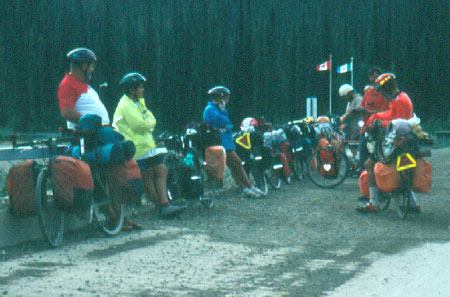
Waiting
six frustrating hours near Miner's Junction
The next morning I went to the nearest bicycle shop and bought a longer
stem for my mountain bike. The pain in my hands and wrists was relieved,
and I began enjoying the expedition more than ever. As I cycled toward
Carmacks I composed the following poem to describe my new-found happiness:
I have a new life
with my bike
that makes my feet light
and gives me great might
to trek
over any speck
of gravel and bramble.
My wrists and hands
hurt no more
like afore,
and my eyes see more and more
of this beauty that I adore.
Of course, I am
speaking about
my new stem.
In
Carmacks we joined The Three Musketeers who made it unharmed past the
forest fires. In fact, they proudly claimed that their rugged ride on
the Robert Campbell Highway was the highlight of the expedition. For
them it was a true adventure. For me it would have been sheer hell.
Apart from those caused by my short bicycle stem, I had my own difficulties
on the North Star expedition. At various campgrounds along the route,
I encountered hordes of mean blood-sucking mosquitoes, nasty flesh-eating
flies, and pesky food-stealing squirrels. And in British Columbia two
black bears threatened my safe passage. One bear was about one hundred
yards directly in front of me, and the other bear was feeding in tall
grass alongside the highway. Fortunately, a man in a pickup truck came
by and saw my predicament. He stopped, stepped out of his truck with
a 12-gauge shotgun, and fired it once into the air. Immediately, both
bears scampered away, and I hightailed it down the highway as fast as
I could pedal.
Unforgettable
characters
In balance with these unfortunate difficulties during the expedition,
I had the pleasure of meeting several very interesting people. Most
memorable was Mighty Moe, a fellow who lived in a ramshackle trailer
beside a beautiful lake along an isolated stretch of highway near the
Yukon border. Moe was an elderly bachelor who had a long white beard
and rosy cheeks. He was dressed in a shabby short-sleeved shirt and
dirty baggy pants held up by an old leather belt.
I had heard many stories about Mighty Moe. Some people said that he
used to work as a clown in a circus. Others claimed that Moe was an
old sourdough who prospected for gold for many years but never struck
it rich. And still others said that he was a trouble-making, good-for-nothing
alcoholic. There was no doubt about one thing: Moe was a nonstop raconteur
of tall tales. During our two-hour visit he never once stopped talking
to me.
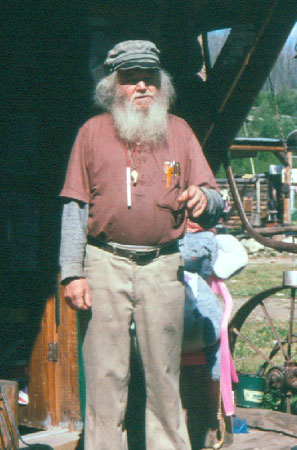
Mighty Moe
Moe made his living mainly by renting camping space to visitors who
arrived in their recreational vehicles. On his property he built many
interesting things to see, including a variety of whimsical structures.
One such structure was an old outhouse with an appropriate sign attached
to it: "HOLES." The interior of the outhouse was wallpapered
with outdated calendars, and it even had an old-fashioned telephone
that was not connected to any telephone wire. "I put that phone
in there just in case someone wanted to make a call to nowhere,"
Moe said with a chuckle.
Another interesting person whom I met on the expedition was Robert Baker
who was hunting mountain sheep with the use of his small airplane. He
landed directly on the Alaska Highway, taxied his plane to the gas pump
at Dot Lake Lodge, and refueled. After chatting with the owner of the
lodge, Robert took off on the highway into a spectacular sunset. It
was a scene right out of the television series "Northern Exposure."
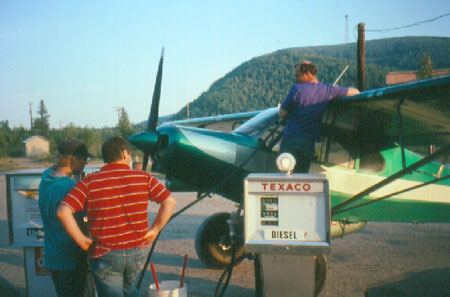
Robert Baker feeds his hungry plane.
On
to Denali
After a two-day visit in Fairbanks, I headed toward Denali National
Park. On the way there I saw a large sign beside the highway: "CAUTION:
Windy Area Next Mile." That message was no joke. Several times
tremendous headwinds knocked me off my bike. At times I could not pedal
faster than three miles per hour. My legs protested with pain as I pushed
down harder and harder on the pedals. I inched forward very, very slowly.
To make matters worse that day, I experienced one of the most terrifying
moments of the expedition. Shortly before arriving at the entrance to
Denali I approached a narrow bridge that spans the Nenana River flowing
174 feet below me. I looked in my rearview mirror and saw that a car
was following very closely behind me. I could see that the car was loaded
with a family and their camping gear. Undoubtedly they were on their
way to visit Denali, and it was obvious that the driver desperately
wanted to pass me. I looked up ahead. On the other side of the highway
two motorcycles were racing toward me. Instinctively, I stuck out my
left hand to signal to the driver of the car behind me to slow down
so I could cross the bridge safely. The strategy worked but I was still
shaking as the anxious fellow zoomed by me as soon as I reached the
other side of the bridge.
Finally I arrived at Denali which was one of the highlights of the North
Star expedition. There was a great deal to see and do in the park: wildlife
films, dog sled demonstrations, nature hikes, bus tours, and camping
in remote areas. On a trek through Savage River Canyon, I was fortunate
to glimpse a distant view of Mount McKinley, the highest mountain in
North America at 20,320 feet. As I gazed at that magnificent snow-capped
peak, I felt closer to Nature and the Force that created me.
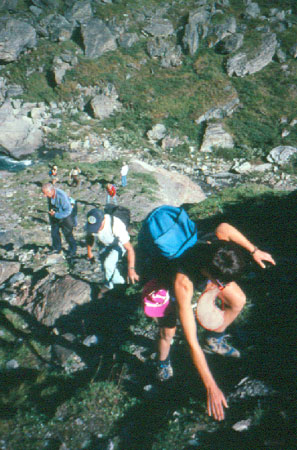
A trek through Savage River Canyon in Denali National
Park
Journey's
end
After spending two days at Denali, my group members and I pedaled southward
to Anchorage where we arrived two days later. We enjoyed our last supper
together at an excellent restaurant located near our campground. We
dined on zucchini with cheese, grilled halibut, and strawberry cheese
cake -- all of which we washed down with cold draft beer.
As we indulged, we chatted the evening away about the unforgettable
adventures that we had experienced individually and collectively over
the past seventy-three days. I looked forward with great enthusiasm
to my next long-distance bicycle journey.
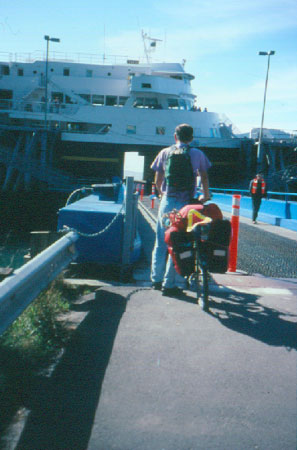
Off to Bellingham by ferry
|